
The demand for a limited-slip differential (LSD) originally arose in motorsport. When Ferdinand Porsche noticed that his Auto Union Silver Arrow race car was still generating wheelspin at 160 km/h with its 5-litre supercharged V16 producing 375 hp, he commissioned ZF in 1935 to come up with a solution.

The result was a Gleitsteinsperre — a German term for which there is no direct equivalent, best described as a sliding-block differential. In essence, it is a limited-slip unit based on sliding blocks (“Steine”) that work their way between specially profiled cam rings (“sun gears”). As soon as the wheel speed difference across the axle becomes too great, the mechanism locks up and jumps abruptly from 5% locking to 100%. This principle is harsh in operation and requires periodic overhaul.
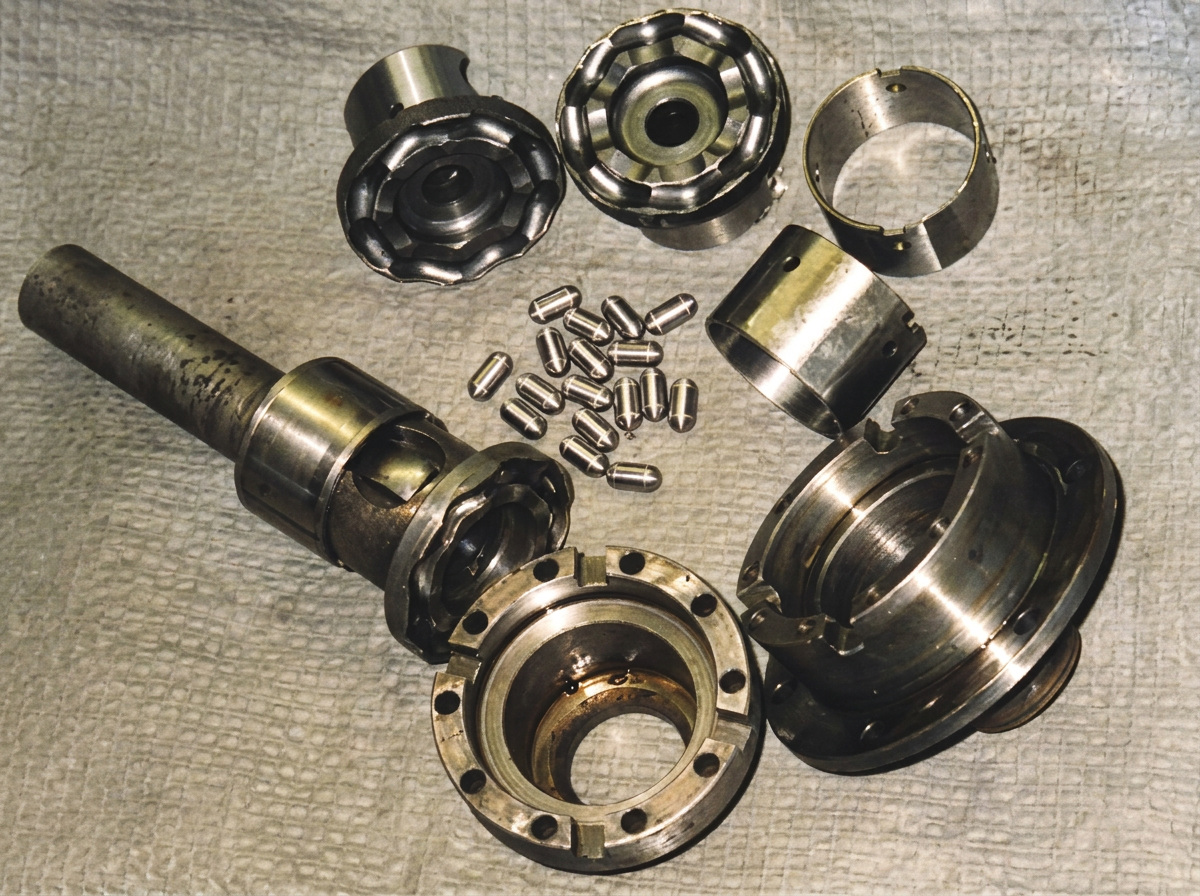
Since then, many different designs have been conceived to keep both driven wheels in check, and we notice that our customers often cannot see the wood for the trees amidst inflated marketing claims and scattered forum misinformation.

What an LSD offers in terms of driving dynamics:
How a limited-slip differential affects the handling characteristics and stability of a car can vary significantly depending on the type of LSD, which is why we created the tables below. With very few exceptions, factory-installed OEM differentials are almost always on the mild side. This means they either cannot or are not set up to lock firmly unless modified afterwards. Manufacturers do this to prevent noises such as chattering in tight corners, at the expense of the stability and traction that a motorsport-grade LSD can provide. This is often presented as an unavoidable trade-off — either one or the other — yet there are limited-slip differentials that are both smooth in operation and deliver exceptional feedback and grip.

Predictability – Feedback
A consistent limited-slip differential plays a major role in building driver confidence in the car. A differential that reacts differently in varying situations is much harder to read than one that behaves identically every time. In that respect, an open differential is dreadful because power always takes the path of least resistance, inducing an unpredictable steering effect from the rear axle that continuously shifts depending on input torque at the differential, individual wheel grip, and steering angle.
In principle, Torsen and viscous limited-slip differentials behave in a similar reactive manner: torque, available grip, and steering angle dictate where the power goes, and only once one wheel begins to slip does the differential intervene to correct it.
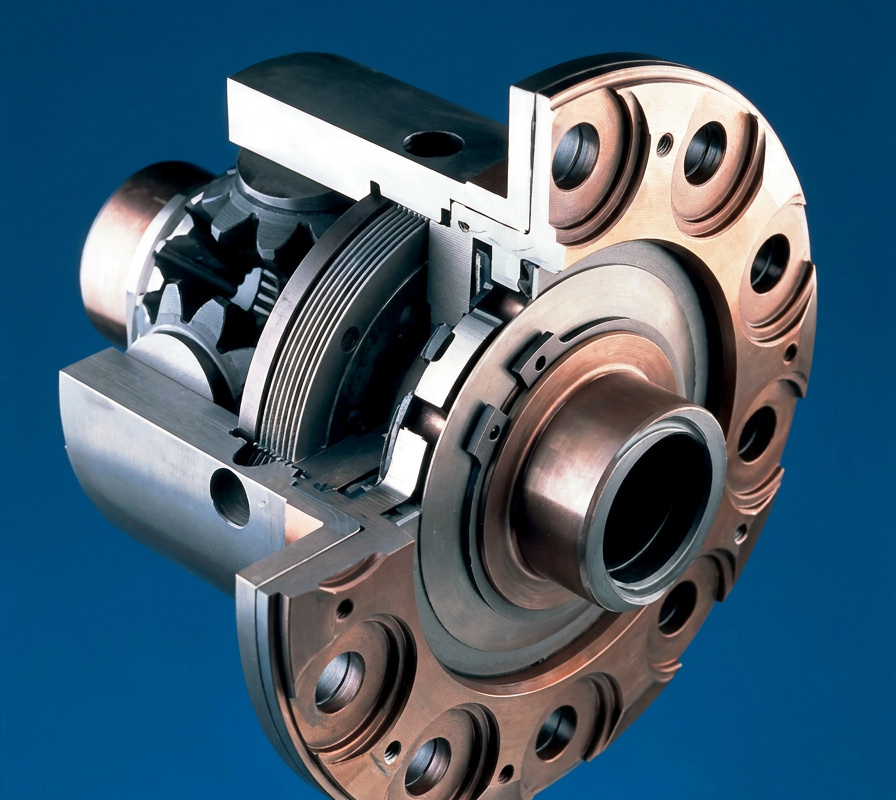
A mechanical clutch-type (plate) LSD operates differently: it processes the input torque before it reaches the wheels, clamping the clutch packs more or less firmly depending on how much torque enters the differential — directly translating into more or less locking. For the driver, this is far more predictable because the locking force scales directly with throttle input rather than depending on an elusive variable such as surface grip. Combined with a setup firm enough to deliver clear feedback, this provides a substantial boost in driver confidence and traction both at and beyond the limit of tyre grip.

With an electronically controlled clutch-type differential, this purely mechanical principle no longer applies. Instead, it introduces an array of external parameters into the equation — such as driving mode (Comfort, Sport, etc.), steering angle, brake pressure, throttle pedal position, oil temperature, and more. Consequently, predictability for the driver becomes more elusive and heavily dependent on the manufacturer’s factory calibration.
Comparison Table
In the table below, we outline how the various types of limited-slip differentials stack up against one another. Please note that Table 1 is a subjective evaluation based on our practical motorsport experience and engineering insight.
Rated on a scale from 0 to 10, where 10 is the highest achievable score.
Sper differentieel database
| Sper model/Functies | Performance/grip | Duurzaamheid/revisie kosten | Sterkte/Tuning geschikt | Afwerking/Hoe goed gemaakt | Verstelbaarheid | Installeerbaarheid/plug and play | Prijs kwaliteit verhouding | Soepelheid van de werking | Driftgeschikt | Beschikbaarheid op de markt |
|---|---|---|---|---|---|---|---|---|---|---|
| Racing diffs lsd conversie | 1 | 3 | 2 | 5 | 0 | 7 | 5 | 2 | 3 | 8 |
| Oem visco sper | 2 | 4 | 4 | 6 | 3 | 7 | 5 | 9 | 2 | ? |
| Oem Torsen | 3 | 7 | 5 | 6 | 0 | 9 | 6 | 8 | 5 | 4 |
| GKN M variable | 3 | 7 | 6 | 6 | 0 | 9 | 6 | 9 | 6 | |
| Mfactory torsen | 4 | 7 | 6 | 7 | 0 | 7 | 5 | 8 | 5 | 8 |
| Quaife torsen | 4 | 9 | 8 | 8 | 0 | 9 | 6 | 8 | 5 | 8 |
| 3J NXG | 5 | 2 | 1 | 4 | 7 | 5 | 5 | 8 | 6 | 5 |
| Wavetrac torsen | 5 | 9 | 8 | 8 | 0 | 9 | 6 | 8 | 5 | 8 |
| PG torsen | 4 | 9 | 5 | 4 | 0 | 9 | 7 | 8 | 5 | 7 |
| ZF platensper | 6 | 5 | 5 | 6 | 8 | 8 | 9 | 5 | 7 | 4 |
| Kaaz | 7 | 6 | 7 | 7 | 8 | 5 | 7 | 6 | 8 | 7 |
| Mfactory platensper | 7 | 6 | 7 | 7 | 8 | 6 | 5 | 6 | 8 | 7 |
| Cusco RS | 7 | 6 | 7 | 7 | 8 | 7 | 6 | 6 | 8 | 7 |
| ATS Metal | 7 | 6 | 7 | 7 | 8 | 7 | 7 | 6 | 8 | 6 |
| Gripper | 7 | 6 | 9 | 7 | 8 | 7 | 7 | 6 | 8 | 7 |
| Drexler | 8 | 6 | 9 | 9 | 8 | 9 | 5 | 7 | 9 | 8 |
| ATS Carbon | 8 | 8 | 9 | 8 | 8 | 7 | 6 | 8 | 9 | 6 |
| OS Giken superlock TCD | 9 | 9 | 8 | 9 | 9 | 9 | 7 | 9 | 8 | 7 |
| OS Giken superlock | 9 | 9 | 8 | 9 | 9 | 9 | 8 | 8 | 9 | 8 |
| Elektronisch rem-sper | 1 | 6 | 6 | 0 | 0 | 9 | 2 | 9 | 1 | |
| E-diff | 9 | 7 | 7 | 7 | 9 | 5 | 6 | 9 | 8 | |
| Open differentieel | 0 | 9 | 4 | 4 | 0 | 9 | 5 | 4 | 0 | 10 |
| Vastgelast differentieel | 5 | 9 | 9 | 3 | 0 | 9 | 7 | 0 | 8 | 10 |
| OS Giken dual core | 8 | 8 | 8 | 9 | 8 | 9 | 8 | 6 | 8 | 1 |
| Eaton Truetrac | 4 | 9 | 7 | 8 | 0 | 9 | 6 | 8 | 5 | 8 |
Table 2 provides an overview of the same available limited-slip differentials, assessed strictly on objective functional specifications.
Sper differentieel database 2
| Sper model/Functies | Verstelbaar | Onderhoudsvrij | Reviseerbaar | Sper bij acceleratie | Sper bij deceleratie | Voordruk | Negatieve voordruk | Buitenaf verstelbaar |
|---|---|---|---|---|---|---|---|---|
| Racing diffs lsd conversie | Nee | Nee | Ja | Ja | Ja | Ja | Nee | Nee |
| Oem visco sper | Zeer beperkt | Nee | Soms | Ja | Ja | Een beetje | Nee | Nee |
| Oem Torsen | Nee | Ja | Soms | Ja | Nee | Een beetje | Nee | Nee |
| GKN M variable | Nee | Nee | Nee | Ja | Ja | Ja | Nee | Nee |
| Mfactory torsen | Nee | Ja | Ja | Ja | Nee | Ja | Nee | Nee |
| Quaife torsen | Nee | Ja | Ja | Ja | Nee | Ja | Nee | Nee |
| PG torsen | Nee | Ja | Ja | Ja | Nee | Ja | Nee | Nee |
| Eaton Truetrac | Nee | Ja | Ja | Ja | Nee | Ja | Nee | Nee |
| 3J NXG | Ja | Nee | Ja | Ja | Ja | Ja | Nee | Nee |
| Wavetrac torsen | Nee | Ja | Ja | Ja | Nee | Ja, dynamisch | Nee | Nee |
| ZF platensper | Ja | Nee | Ja | Ja | Ja | Ja | Nee | Nee |
| Kaaz | Ja | Nee | Ja | Ja | Ja | Ja | Nee | Nee |
| Mfactory platensper | Ja | Nee | Ja | Ja | Ja | Ja, spiraalveer | Nee | Nee |
| Cusco RS | Ja | Nee | Ja | Ja | Ja | Ja, spiraalveer | Nee | Nee |
| ATS Metal | Ja | Nee | Ja | Ja | Ja | Ja | Nee | Nee |
| Gripper | Ja | Nee | Ja | Ja | Ja | Ja | Nee | Nee |
| Drexler | Ja | Nee | Ja | Ja | Ja | Ja | Nee | Optioneel op sommige modellen |
| ATS Carbon | Ja | Bijna | Ja | Ja | Ja | Ja | Nee | Nee |
| OS Giken superlock TCD | Ja | Ja | Ja | Ja | Ja | Ja | Ja | Nee |
| OS Giken superlock | Ja | Ja | Ja | Ja | Ja | Ja | Ja | Nee |
| Elektronisch rem-sper | In principe wel | Ja | Nee | Ja | Ja | Nee | Nee | Ja |
| Elektronisch platensper-sper / E-diff / Active M diff | Ja, actief | Bijna | Soms | Ja | Ja | Nee | Nee | Ja |
| Open differentieel | Nee | Ja | Nee | Nee | Nee | Nee | Nee | Nee |
| Vastgelast differentieel | Nee | Ja | Nee | Ja | Ja | Nee | Nee | Nee |
| OS Giken dual core | Ja | Bijna | Ja | Ja | Ja | Ja | Nee | Nee |
Legend:
Adjustable:
Adjustability is primarily relevant in motorsport, where changing the locking characteristics for wet conditions or varying track surfaces during an event can be crucial. For a road car, internal adjustability has traditionally been less of a factor, as owners are not expected to regularly remove and disassemble their differential to alter the setup.
However, it is vital that your differential is properly configured beforehand, as re-tuning an installed unit to suit your preferences later is labour-intensive. The supplier of the limited-slip differential must therefore possess thorough technical expertise to deliver the unit with the correct setup right out of the box.

Maintenance-free:
Strictly speaking, no differential is completely maintenance-free. Every unit requires periodic oil changes, although service intervals vary from one design to another. We also frequently see Torsen manufacturers suggest that a clutch-type LSD regularly needs replacement friction plates. In reality, premature plate wear only occurs when the setup is underspecified for the application, allowing the car’s torque to continuously slip through the clutch pack.
Torsen differentials use thrust washers, preload springs, and/or shim plates to keep the worm gears tightly seated inside the carrier housing. Over time, these components wear down as well; once they lose their tight fit and allow play inside the differential casing, the unit begins to clunk on load transitions and stretches the axle shaft oil seals.

Rebuildable:
Can the differential casing be opened up for a refresh, and are spare parts available to replace damaged or worn internals? Even though certain types of limited-slip differentials do not require scheduled overhauls, mechanical failures can always happen, making spare part availability a major advantage.

Locking on acceleration:
Locking under acceleration is usually the primary reason to install a limited-slip differential. Acceleration places the greatest stress on both the differential and the tyres, where the risk of spinning an unloaded wheel is highest.

Locking on deceleration:
Locking under braking and overrun is a somewhat more debated topic, yet it is a proven fact that many racing applications rely heavily on deceleration locking. Deceleration lock provides greater stability and composure when braking into corners, improved control during oversteer situations in both front- and rear-wheel-drive cars, and is particularly crucial in cars with the engine mounted over or behind the rear axle.
Preload:
Preload defines the static initial locking torque of a limited-slip differential. Almost every LSD features dynamic locking behaviour, meaning it applies varying force to keep both driven wheels rotating at the same speed. Preload ensures that under zero-load conditions this dynamic behaviour never drops all the way back to that of an open differential. This prevents all drive torque from being sent to an unloaded wheel with zero resistance. By design, a clutch-type LSD can accommodate significantly higher preload than a Torsen unit.
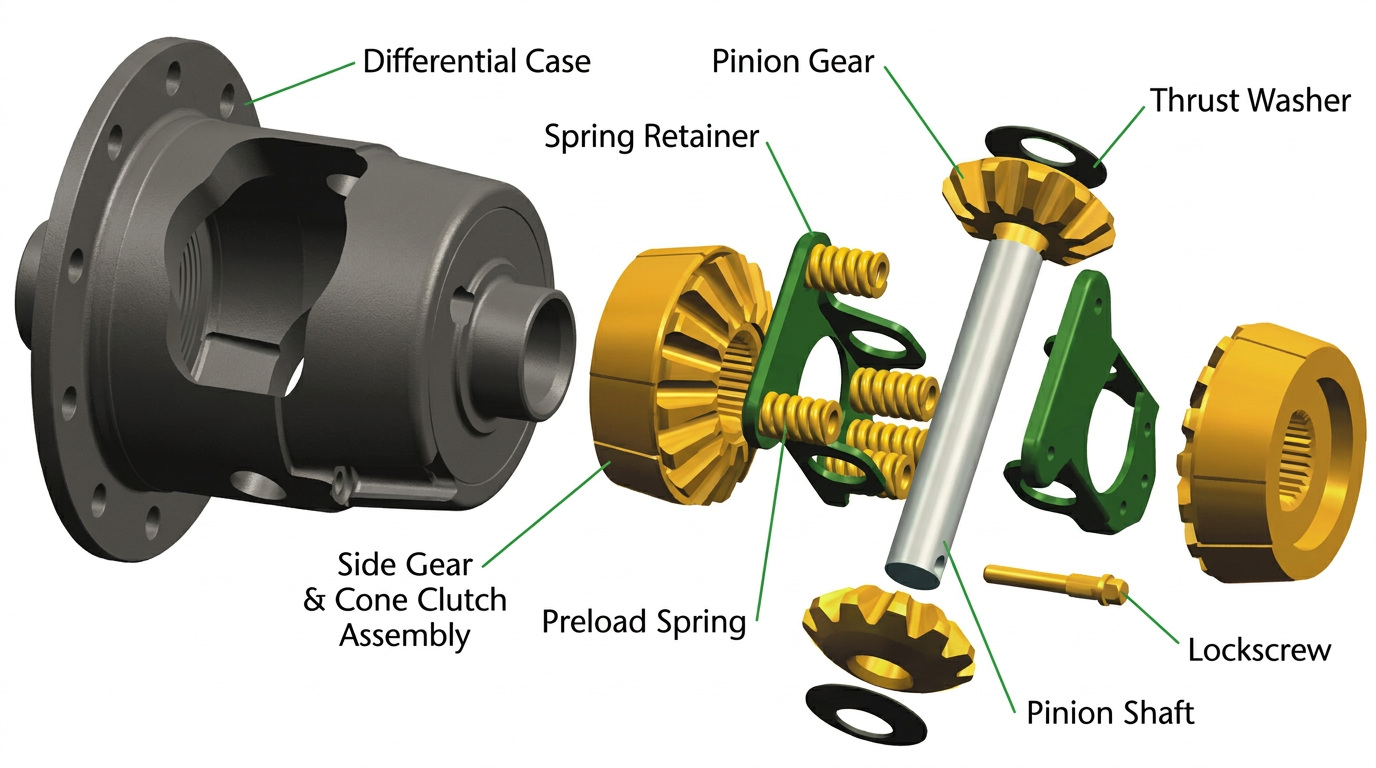
Negative preload:
Negative preload is likewise achieved using internal springs, positioned differently to oppose the opening of the pressure rings. Negative preload counteracts and regulates the dynamic build-up of locking force, resulting in smoother progressive engagement, broader tuning options, and a wider dynamic operating range. Thanks to this finer control, more clutch plates can be employed without immediately creating an overly aggressive differential.

Externally adjustable:
Externally adjustable differentials come in several forms. Today, many modern cars leave the factory with differentials equipped with an electric motor that varies the locking force — as seen on the BMW F80 M4, for example — or use electronically or hydraulically controlled clutch packs on the output shafts to achieve active torque vectoring. In motorsport, electronically controlled differentials are prohibited in some series, and they remain a relatively costly option. Manually externally adjustable aftermarket LSDs also exist, though their external adjustment is limited strictly to altering preload.

If you have any questions, comments, or interest in a limited-slip differential, you can browse our webshop to see the options available for your car, and please feel free to contact us for further information, availability, and installation services.