
Every car with a manual gearbox has a clutch. The clutch is the drivetrain component capable of engaging or disengaging the mechanical connection between the engine and the drivetrain. This is essential in order to change gears with the gearbox. Held firmly against the flywheel by heavy-duty springs, the clutch assembly broadly consists of three components: the flywheel, the friction disc, and the pressure plate. Below, we explain which modifications to this part of your car are worthwhile for your application.

Flywheel:
Strictly speaking, the flywheel is part of the crankshaft assembly. Many manufacturers even list the flywheel as part of the crankshaft group in their parts catalogues. The flywheel serves several distinct functions:
- Starter ring gear – The flywheel carries a toothed ring gear driven by the starter motor
- Damper – The flywheel is used to damp torsional vibrations and firing pulses from the engine, making power delivery smoother.
- Clutch friction surface – The flywheel commonly serves as the opposing friction face for the clutch friction disc.
- Trigger wheel – On certain models, the flywheel features a tone ring that supplies crankshaft position data to a sensor for engine timing.
- Housing for the pilot bearing (which supports the tip of the gearbox input shaft)

Dual-mass flywheel:
Many cars rolling off the production line today are equipped with a dual-mass flywheel (DMF). A dual-mass flywheel essentially consists of two flywheel masses interconnected by an internal spring-and-damper mechanism. This damps shock loads through the drivetrain while also reducing vibrations and drivetrain noise. In effect, it acts like an elastic buffer between the engine and the driven wheels.

The advantages of a dual-mass flywheel:
- Damping of drivetrain shock loads, which benefits the longevity of your drivetrain.
- Reduction of vibrations and noise, improving refinement and comfort.
- Makes smooth gear shifts slightly easier to achieve.
Disadvantages of a DMF:
- Relatively complex construction, bringing drawbacks such as higher cost.
- Contains multiple internal components subject to wear and mechanical failure, eventually requiring replacement.
- A dual-mass flywheel is calibrated to the torque characteristics and output of the standard engine; if engine output is increased through tuning, the dual-mass flywheel may no longer cope with the torque.
- Relatively heavy and difficult to lighten because the internal mechanism requires a considerable number of parts. That extra rotational mass absorbs engine power every time revs build and adds to the overall weight of the car.
Flywheel Simulator:
Vergelijk 4 vliegwiel- en koppelingscombinaties op exact dezelfde personenautomotor.
Atmosferische Motor (N/A): Grootste Procentuele Winst & Gasrespons
Een atmosferische motor haalt zijn vermogen uit toeren met een gematigd koppel. Een zwaar 240mm DMF + OEM drukgroep slokt in zijn 1 en 2 een flink deel van de versnellingskracht op. Met een stalen licht vliegwiel en compacte Ø184mm of Ø215mm koppeling wint een N/A motor direct voelbaar aan trekkracht en schakelscherpte.
Turbomotor: Snellere Spool & Minder Boost-Drop, maar Kies Gedempte Koppeling!
De auto zelf (>1.350 kg) zorgt op straat en circuit voor ruim 85% van de motorbelasting: de turbo spoelt met een lichte set dus prima op en bereikt zijn boost-toerental eerder, met minder drukverlies bij schakelen. Omdat turbomotoren rond 2.000 tpm al hoge cilinderdrukken leveren, adviseren wij op 3-, 4- en 5-cilinder turbo's vrijwel altijd een gedempte Ø215mm of geveerde koppeling.
De Mythe: "Een zwaar vliegwiel heeft meer koppel"
Ontstaat puur bij wegrijden vanuit stilstand: een zwaar dubbelmassa vliegwiel met 240mm OEM koppeling slaat extra kinetische energie op en zakt bij lui koppelen minder snel in toeren. Dat is een geleende energiebuffer van een halve seconde, géén motorvermogen.
Waarom geen aluminium vliegwiel, maar één-delig staal + kleine koppeling?
Aluminium vliegwielen hebben altijd een losse stalen starterkrans én een opgeschroefd stalen frictievlak nodig die onder hitte verschillend uitzetten. Met een één-delig chromoly stalen vliegwiel en een Ø184mm of Ø215mm racekoppeling vervalt het zware buitenste frictievlak en bereik je op betrouwbare wijze een veel lagere massatraagheid.
Live Mechanische Doorsnede (Ø184mm / Ø215mm / Ø240mm) & Totale Traagheidsopbouw
Donkerblauw = Motor intern (krukas/zuigers/poelie) | Staalblauw = Koppeling | Oranje = Stalen Vliegwiel| Combinatie (Altijd Staal) | Traagheid & Buitenring | Schakelen & Tussengas | Cilinder-Balans & NVH | Aanbevolen Gebruik |
|---|---|---|---|---|
| Ø184mm Ongedempte Racekoppeling + Licht Stalen Vliegwiel | Laagst mogelijke traagheid (Jset = 0,052 kg·m²): geen frictievlak nodig in de buitenste ring van het vliegwiel, alleen de stalen starterkrans. | Maximale wiel-pk winst en bliksemsnel terug- en opschakelen op hoge toeren zonder slepende plaat. | Op een 6-in-lijn, V8, V10 of V12 verrassend beheersbaar; op een 3- of 4-cilinder geeft ongedempt duidelijke bakratel onderin. | Circuit, Race, Rally, Drift & Time Attack. |
| Ø215mm Gedempte Racekoppeling + Licht Stalen Vliegwiel (bijv. OS Giken) | Compacte Ø215mm diameter houdt buitenrand-traagheid zeer laag (Jset = 0,081 kg·m²) bij hoge koppelcapaciteit. | Zeer gretig op tussengas, strak maar goed doseerbaar aangrijpingspunt en vrij van rev-hang. | Torsieveren in het koppelingshart vangen schakel- en verbrandingspieken op — ideaal voor zowel 4/5/6-cilinder Turbo als V6 / 6-in-lijn N/A. | Trackday, Clubsport, Drift & Krachtige Straat/Circuit-auto's. |
| Licht Enkelmassa Stalen Vliegwiel + Zware Ø240mm OEM Koppeling | Vliegwiel zelf is licht (~6,3 kg), maar de grote 240mm OEM drukgroep voegt aan de buitenrand nog ~0,072 kg·m² toe (Jset = 0,140 kg·m²). | Duidelijk vlotter op het gas dan origineel DMF, met exact hetzelfde lichte pedaalgevoel en brede OEM aangrijpingspunt. | Geveerde organische 240mm plaat houdt straatcomfort hoog; lichte transmissierinkel alleen bij zeer laag toerental op 3/4-cilinders. | Fast Road, OEM+ & Dagelijks Sportief Straatgebruik. |
| Zwaar Dubbelmassa OEM Vliegwiel (DMF) + Zware Ø240mm OEM Koppeling | Hoogste roterende massa (Jset = 0,243 kg·m² → +549 kg spookmassa in 1e versnelling), kost merkbaar wielvermogen bij accelereren. | Veel draai-buffer bij lui wegrijden op hellingen, maar traag op tussengas en sterke rev-hang bij sportief schakelen. | Lange boogveren isoleren zelfs bij onrustige 3-cilinders, diesels en V6-motoren vrijwel 100% van de bakratel, maar kunnen slecht tegen circuit-hitte. | Puur woon-werkverkeer, comfort & zwaar aanhangerwerk. |
Clutch:
The clutch is the component designed to interrupt the mechanical connection between the engine and the gearbox. Because an internal combustion engine cannot easily be stopped and restarted instantaneously, it is essential that it can be temporarily disengaged from the drivetrain—both for coming to a standstill and pulling away, and for shifting between gears. When the clutch pedal is depressed, the diaphragm spring is compressed, releasing the clamping force exerted on the clutch plate. This allows the gearbox input shaft (splined into the clutch disc hub) to rotate freely. As you release the clutch pedal, the pressure plate / diaphragm spring re-applies clamping pressure to the friction disc. Once it engages, the gearbox input shaft rotates together with the engine crankshaft. In effect, it acts as an on/off switch for the drivetrain. See this illustration from Xtreme Clutch for a cutaway view of the clutch in operation:

Flywheel performance upgrades
Because comfort is far less of a priority on track or in other branches of motorsport, a heavy factory flywheel is no longer ideal. The most common reason for upgrading to a single-mass lightweight flywheel is reducing rotational weight. Increased structural durability or compatibility with a dedicated motorsport clutch can also be key reasons.
Reduced weight
The lighter the flywheel, the easier it is for the engine to accelerate and decelerate—and consequently for your car as a whole to accelerate and decelerate. Crucially, mass close to the rotational axis counts for far less than mass at the outer perimeter of the flywheel. For instance, a 250 mm, 5 kg flywheel can require more energy to spin up than a 200 mm, 6 kg flywheel.
There is good reason why a Formula 1 clutch fits roughly in the palm of your hand:

A lightweight flywheel reduces rotational inertia, allowing the engine to spin up more freely and rev more eagerly.
The advantages of a lightweight flywheel are:
- More net power at the driven wheels due to lower parasitic energy loss accelerating the flywheel.
- Builds revs more freely.
- Sharper throttle and engine response.
- More precise heel-and-toe downshifts because the engine responds faster to throttle blips.
“Does a lighter flywheel cost torque?” No—torque and horsepower are outputs generated by the engine itself, determined by how rapidly and efficiently fuel and air are processed. The flywheel merely damps and stores rotational energy from the output the engine produces; therefore, the lighter the flywheel, the more power and torque reach the driven wheels under acceleration. Take a spinning top as an analogy: a very heavy top requires a great deal of energy to get up to speed, with the only difference being that all that stored kinetic energy also makes it harder to slow down. A light top can be spun up rapidly and with minimal energy input, slows down more readily, and will therefore spin for a shorter time once left to coast.
Alternative clutch interface
Another primary function of the flywheel is serving as the mounting interface for the clutch. A further way to reduce drivetrain inertia is by fitting a more compact motorsport clutch. However, a 140 mm diameter racing clutch will not fit an original factory flywheel—it requires a dedicated flywheel. Designing a flywheel specifically for a smaller-diameter clutch allows its mass and geometry to be fully optimised, such as this flywheel engineered for a 140 mm clutch:

Durability (single-mass flywheel upgrade):
A single-mass flywheel is typically machined from a single billet of steel, making it as strong as structurally possible—especially when manufactured from high-tensile alloy steel. Our TTV flywheels, for example, are CNC-machined from one-piece billet chromoly steel, whereas OEM flywheels are commonly made from cast iron or cast steel and assembled from multiple parts. Chromoly steel has been used and approved in Formula 1, even if contemporary F1 teams may have moved on to even more exotic alloys. Consequently, a billet single-mass lightweight flywheel is substantially stronger and balanced to far tighter tolerances, as these units are engineered specifically for motorsport applications where sustained high engine speeds matter.
Clutch performance upgrades:
Selecting an upgraded clutch involves balancing several technical trade-offs and depends on a range of factors, including:
- Budget
- Intended use (is it strictly a track car, or do you still need to drive five levels up a multi-storey car park?)
- Mechanical load (increased engine power/torque, vehicle weight, or clutch kicks in drifting)
- Maximum engine RPM
- Flywheel specification: lightweight, heavy, OEM, dual-mass, or single-mass
Budget:
Everyone prefers to keep costs low, but it pays to weigh short-term savings against long-term cost. Buying the cheapest clutch option carries the risk that it is underspecified for your application—particularly when running higher output than standard. That can result in the clutch slipping at just 70% throttle, accelerating wear dramatically and proving far more expensive in the long run. Choosing a clutch capable of holding full torque without slipping (with your foot fully off the pedal) is essential for long-term durability.
Choosing an uprated clutch that bolts directly onto your existing flywheel saves considerable expense by retaining the factory flywheel, though it does restrict your clutch options. A twin-plate clutch, for example, is generally not available for a standard OEM flywheel.
Intended use:
Several types of friction material are used across clutch plates and friction discs. As standard, vehicle manufacturers fit organic clutch linings. Within organic linings there are variations—such as the steel or copper content blended into the compound—that alter the friction coefficient. In dedicated racing clutches, sintered metallic, cerametallic (cera-metallic), or carbon friction materials are most widely used. Understanding the properties of each compound ensures you match the clutch to how the car is driven:
Organic:

Organic friction discs are generally cost-effective and readily available. While supplied primarily for OEM and fast-road applications, several motorsport clutch manufacturers also offer organic linings as an option.
The advantages: Cost-effective, relatively tolerant of slipping during engagement, smooth and progressive modulation.
The disadvantages: Limited resistance to very high temperatures, comparatively modest friction coefficient (grip).
Sintered / Cera-metallic:

Sintered and cerametallic clutches are available for a wide range of OEM-style pressure plates, though they are seen predominantly in dedicated motorsport clutches. This compound still modulates predictably while offering a high coefficient of friction—so it bites hard, though that aggressive friction can also accelerate wear on the opposing flywheel and pressure plate surfaces.
The advantages: High grip and torque capacity, strong resistance to high temperatures, controllable modulation, relatively cost-effective.
The disadvantages: Not suited to prolonged slipping on the pedal—especially when hot—so riding the clutch causes rapid wear. Because sintered metallic material is extremely hard, slipping it machines material aggressively off the flywheel friction surface.
Many drivers associate a sintered clutch with harsh, on/off engagement. That happens because a sintered friction disc is best paired with a higher-clamp pressure plate; with a weak pressure plate, the disc can slip under load and wear out prematurely. A stiffer pressure plate applies high clamping load to the disc—ensuring strong bite and minimal slip—but also produces a heavy clutch pedal. A heavy pedal is difficult to modulate smoothly and creates a pronounced on/off feel (partly due to budget pressure plate designs that simply increase diaphragm spring stiffness in a crude way).
A sintered clutch does not necessarily have to have a heavy pedal.
Carbon:

Carbon is a far less common friction material, both because of its high cost and because its operating characteristics suit pure motorsport much better than road use. Carbon requires heat to generate proper friction, meaning the clutch will slip noticeably when cold and only begins to bite cleanly once everything reaches operating temperature. Once up to temperature, carbon tolerates slipping very well, modulates progressively, and is exceptionally light—relieving load on your gearbox synchromesh rings and promoting rapid gear shifts.
Mechanical load (increased engine power, vehicle weight, or clutch kicks in drifting)

The greater the load placed on the clutch, the more clamping force and friction capacity you need to prevent slip. That torque capacity can be achieved using the higher-friction disc materials outlined above, a stiffer pressure plate, or an increased number of clutch plates / friction discs.
Using multiple friction discs (such as a twin-plate or triple-plate clutch) multiplies the number of active friction surfaces, meaning you need neither an overly stiff pressure plate nor large-diameter clutch plates—keeping both rotational mass and pedal effort low.
For severe drivetrain shock loads—such as clutch kicks in drifting, towing heavy trailers, or running dedicated racing engines—an OEM-style pressure plate is often inadvisable, making a purpose-built motorsport clutch engineered to withstand those shock loads the right choice.
High-revving engines:

On high-revving engines, keeping rotating components as light as possible is essential because every kilogram of rotational mass places extra inertial stress on wear-critical parts such as crankshaft bearings. Whatever mass is structurally required should be concentrated within the smallest possible diameter, since mass at a larger radius penalises rotational inertia exponentially.
A small-diameter clutch is therefore optimal, giving the flywheel manufacturer freedom to remove substantial peripheral weight from the flywheel. This allows the engine to climb through the RPM range faster and more effortlessly while minimising mechanical stress on internal wear components.
Dynamic balance is equally critical. For that reason, the flywheels we supply from ATS, OS Giken, and TTV are precision-balanced to ultra-tight tolerances, making them ideally suited to high-revving engines or engines operated consistently at high RPM.
Which flywheel should you use—lightweight, heavy, OEM, dual-mass, or single-mass?
Your choice of clutch depends directly on the flywheel you intend to run. Retaining an original dual-mass flywheel limits pure motorsport clutch architectures, though direct-fit uprated kits are widely available. Sachs Performance and XClutch offer upgrade options across a wide variety of vehicles. Even so, torque headroom with these setups remains finite—doubling factory engine output is rarely successful on an OEM dual-mass flywheel and standard-diameter clutch package.
Converting from a dual-mass flywheel to a single-mass flywheel removes part of the drivetrain’s torsional damping. On a dedicated race car that is rarely an issue, whereas on a road-driven car it is well worth pairing a single-mass flywheel with a sprung (damped) clutch disc.

To match an ultra-lightweight flywheel, you ideally want a low-inertia clutch as well—and as discussed above, preferably a small-diameter multi-plate assembly. Dedicated motorsport clutches are purpose-built for this role.

Clutch problems:
Slipping clutch:
A slipping clutch—typically recognised by engine RPM rising faster than road speed when applying throttle—means the clutch assembly can no longer generate enough clamping force and friction to transmit engine torque to the driven wheels. Common causes include oil or grease contamination, lining wear, an underspecified clutch, or excessive temperatures. Once a clutch begins slipping with the clutch pedal fully released, wear accelerates rapidly and the car can quickly become undriveable.
Needing the very top of the pedal travel before the clutch bites can also indicate that the clutch is worn out and due for replacement.
- Slipping in lower gears under moderate-to-high load usually indicates a worn-out clutch
- Slipping in higher gears at high RPM during hard driving points to excessive clutch temperatures, where a sintered metallic clutch can be a far better choice than an organic lining.
Broken or bent drive strap
To cushion shock loads in the drivetrain, many OEM-style pressure plates locate the pressure ring using tangential drive straps—slightly curved strips of spring steel pulled in tension whenever you accelerate. They handle tensile load very well, but buckle easily when subjected to heavy compressive shock pushing back against them. With aggressive clutch kicks, for example, this can quickly spell the end of your clutch:

Excessive drivetrain backlash, towing overly heavy loads, or a failed crankshaft damper can also cause this type of damage.
Clutch difficult to modulate
A clutch that is difficult to modulate—often referred to as an on/off clutch—is commonly blamed on sintered or racing friction materials, though the friction compound itself is not necessarily the root cause. Even a sintered clutch can be modulated cleanly; however, sintered linings perform best and last longest when slip is kept to an absolute minimum. Consequently, sintered clutches are frequently paired with pressure plates that apply substantially higher clamping pressure to the clutch disc.
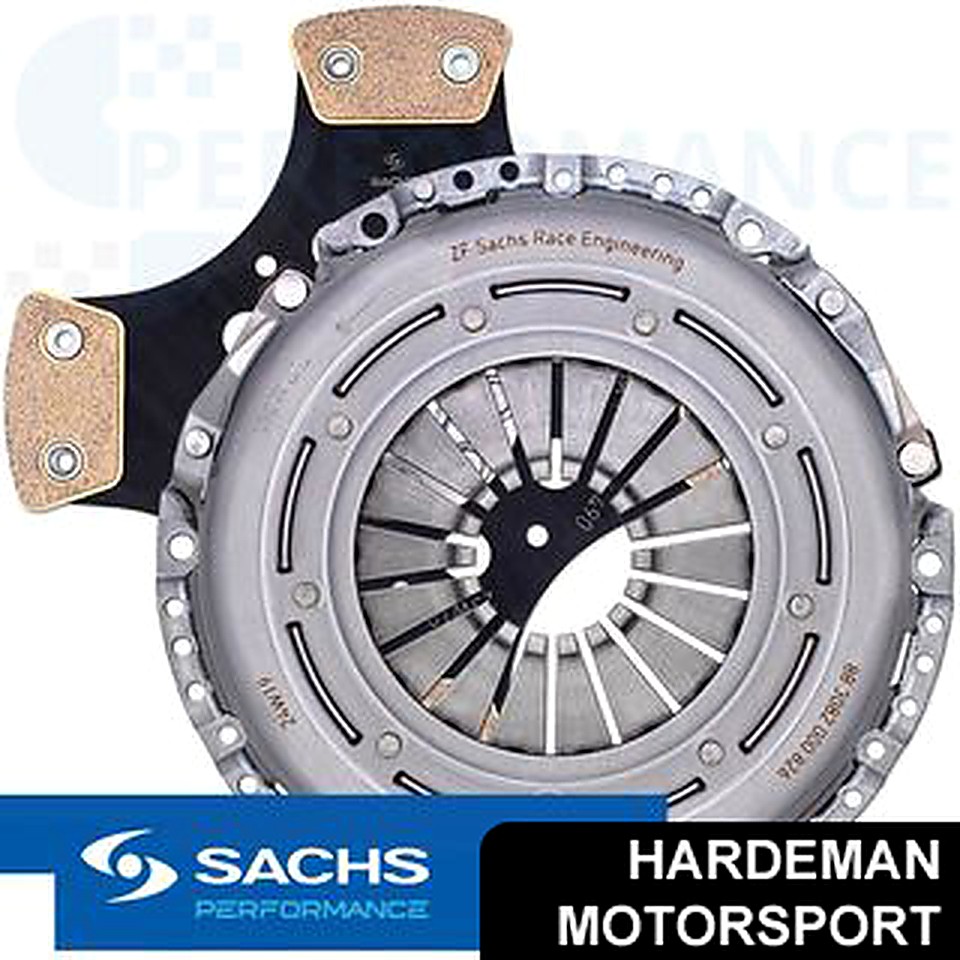
That is where the core issue lies. A stiff pressure plate produces a heavy pedal; pressing a heavy pedal down is manageable enough, but releasing it gradually and smoothly through the bite point is the difficult part. Several solutions address this:
- Practice—familiarity and leg strength will resolve part of the difficulty
- More friction discs—for instance, switching to a twin-plate clutch—means that achieving the same clamping capacity (assuming the same disc type and diameter) requires roughly half the diaphragm spring pressure from the pressure plate, resulting in a much lighter pedal.
- Aluminium clutch cover / pressure plate housing. The standard stamped sheet-steel covers used by every OEM manufacturer flex under diaphragm spring load—especially when fitted with a heavy-duty spring—so part of your heavy pedal effort goes into flexing the cover housing rather than actuating the spring. A billet aluminium clutch cover is far stiffer, transferring that energy much more directly to the clutch plate.
