
Viscous limited-slip differential
A viscous, visco, VLSD, or viscous limited-slip differential is a type of LSD that is virtually non-existent in the aftermarket, yet is frequently fitted from the factory on performance models such as the Ford Sierra, Nissan Z, Chrysler SRT, AMG, Mitsubishi Lancer Evo, or the BMW M Variable Differential Lock (E46, E82 1M Coupé, E90 M3/Z4M, and E60–E63 M5/M6).

A visco-lock operates progressively depending on the difference in wheel speed. Its operating principle differs fundamentally from that of a Torsen or a clutch-type LSD. Whereas those types of LSD respond to torque and available grip, a viscous LSD responds solely to the speed differential between the rear wheels. When driving in a straight line, the differential does nothing at all. However, as soon as the car enters a corner, the outside wheel naturally has to rotate faster than the inside wheel. Once one wheel turns faster than the other, the side gear is forced to rotate at a different speed relative to the differential casing.

As soon as this gear rotates relative to the differential casing, it drives an internal pump that builds pressure against the internal clutch plates inside the LSD unit. The harder these clutch plates are compressed, the greater the locking effect delivered by the unit. When driving calmly around a roundabout, the pump builds so little pressure that you negotiate the roundabout without noticing its presence. Only when a wheel genuinely spins up under excessive throttle does this type of LSD build sufficient pressure for you to feel the increase in traction. Consequently, it is always too late to prevent initial wheelspin, meaning you first have to correct for the momentum already built up: your wheel is already spinning before you feel the rear axle generating traction.
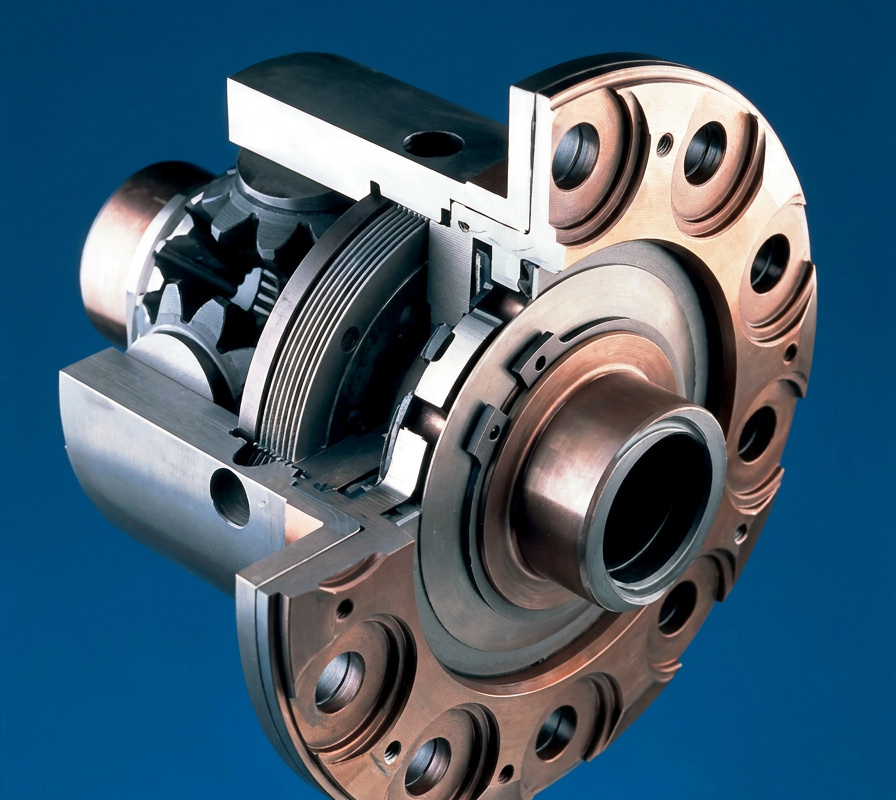
Some degree of tuning is possible on these differentials. Certain units can be filled with higher- or lower-viscosity silicone fluid. Both the number of clutch plates and the differential oil used can influence how the LSD behaves, specifically how slowly or rapidly locking force builds up. However, an overly aggressive setup quickly becomes unpleasant for road use, while an overly mild setup suffers from a lack of initial traction. This type of limited-slip differential sees very little use in motorsport, and many OEM viscous LSD units overheat under heavy load, causing them to lose their locking function.

In terms of traction, it is still an improvement over an open differential, though when a wheel starts spinning you simply have to grit your teeth and wait for the locking action to engage. This type of LSD operates under both acceleration and deceleration.