
Coilover suspension kits come in all shapes, sizes and, above all, prices and colours. So how do you choose the right coilover kit for your application? In this article we aim to point you in the right direction by outlining what you can and should consider when purchasing coilover suspension.
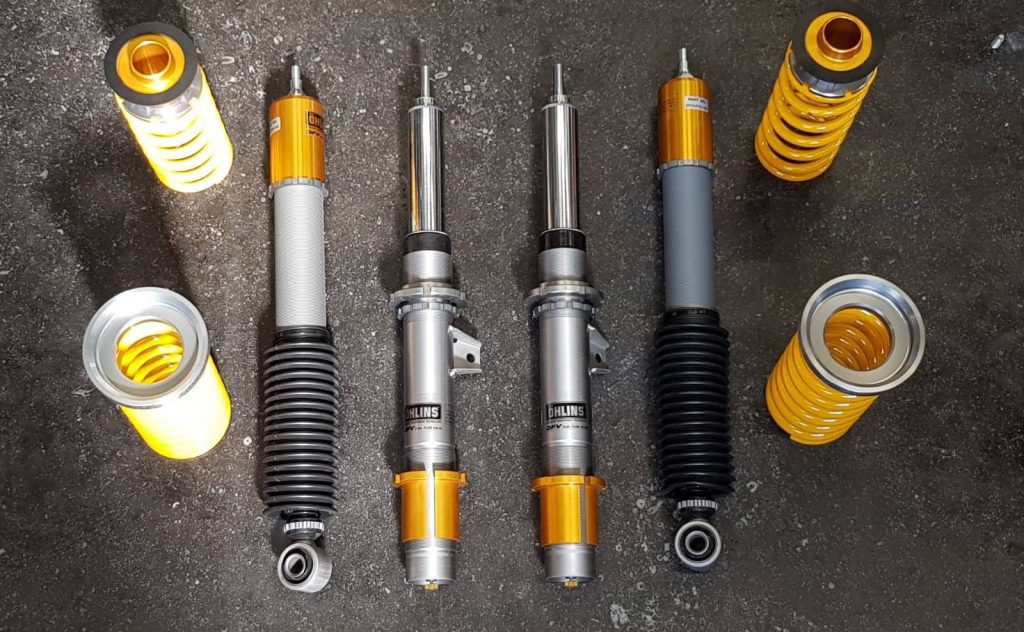
In this article we only refer to kits and brands that we supply ourselves. That does not mean these are the sole, ultimate options for your application, but the brands we recommend have been specifically selected for build quality, durability and sound handling characteristics. The vast majority of a shock absorber’s quality and performance is determined by the machining precision of its internal components. This also dictates the price: machining a spacer or valve component to a tolerance of 0.01 mm rather than 0.1 mm carries a substantially higher manufacturing cost, yet it directly governs damper precision and consistency—such as unit-to-unit matching between the left and right dampers. Unfortunately, none of this can be judged from product photos on the internet.

Over the years we have seen plenty of customer suspension kits pass through our workshop—ranging from very cheap sets to kits costing more than the car itself—suffering from build quality or handling flaws that keep us from stocking those brands. With certain other brands, the level of bespoke specification involved makes it more practical to go directly to the manufacturer rather than ordering through our webshop, especially when they are based in the Netherlands, of which there are plenty (AST, Proflex, Intrax, Reiger). Should you want independent advice or have questions on the subject, we recommend getting in touch with us.

Budget plays a major role, and that is ultimately in your own hands; the best we can do is provide clear technical information alongside a broad product range. Naturally, a higher-end kit has more to offer than a budget set, but based on the technical specifications and our workshop experience, you can make a well-founded choice.
Springs:
Selecting the right springs at the time of purchase is essential for any coilover suspension. Some manufacturers offer guidance here and supply a tailored specification, whereas others supply a single fixed spring set that you have to make do with—making it quite a job to swap springs later if you decide you would prefer something different. Spring rate and spring type are largely responsible for the ride comfort and chassis feedback of your car. Avoid choosing spring rates that deviate drastically from your current springs unless you have entirely different plans for the car. In addition, there is a major difference between high-grade and low-grade springs in terms of durability, rate consistency and usable suspension travel.
Some coilover manufacturers also fit—or omit—rubber isolators on the spring perches. These isolate part of the road vibration and noise, meaning a coilover kit without rubber seats can feel sharper and sportier, whereas rubber seats make a kit better suited to road use.

Linear or progressive springs:
Conventional steel coil springs come in two types: linear (identifiable by a constant coil pitch) and progressive (featuring variable coil pitch or wire diameter). Most OEM manufacturers supply progressive springs, which offer a ride comfort advantage because they start off soft at initial deflection and stiffen progressively as they compress. Linear springs are often firmer initially, but their spring rate increases linearly without a rising curve. As a result, linear springs provide superior chassis feedback and predictability, although they transmit road imperfections more firmly—even if a softer linear spring will still ride more comfortably than a stiff progressive spring. Many higher-quality coilover kits come with linear springs that use a relatively modest spring rate for road use, leaving the damper valving to control the remaining body motion.
Helper springs:
Helper springs are the small, light springs you sometimes see fitted above or below the main spring. Their job is to keep the main spring captive under tension when the suspension reaches full droop, which is often required for roadworthiness inspections (MOT / technical scrutineering). They also add a slight transition at the start of the spring curve, particularly with linear main springs. However, if the main spring is already installed under preload, helper springs serve no purpose whatsoever.

Ride height adjustability:
A coilover suspension only truly earns its name when ride height is adjustable. Lowering the car changes its visual appearance and stance, while for motorsport use ride height adjustability is essential for chassis balance, corner weighting, aerodynamics and suspension travel. Some coilover kits combine spring preload with ride height adjustment via the spring perch, whereas others allow the ride height of the car to be adjusted independently of spring preload via a threaded lower mount.
The advantage of an independent threaded lower mount is a wider adjustment range, yet from an engineering perspective it is far from ideal. The problem is that the damper body itself must be shortened to create room for that lower adjustment sleeve; while that compromise is less severe on some suspension layouts than others, in every case you give up suspension travel. And suspension travel is vital for both ride comfort and mechanical grip. Furthermore, it creates the temptation to set the coilover kit up so that the damper no longer operates within its optimal stroke window (leaving even less usable travel). Many budget (often Taiwanese) manufacturers use this modular system simply because they only have to fabricate a vehicle-specific lower bracket while using one universal damper cartridge across every model—from an MX-5 to a Hummer, so to speak. That keeps production costs low, but does not automatically result in a better chassis or driving experience. Another drawback is that this extra threaded lower sleeve joint is neither as strong nor as rigid as a fixed lower mount, even though structural rigidity there is crucial for steering feedback, proper damper and spring operation, and safety.

Twin-tube or monotube:
Twin-tube
The twin-tube damper is the original design and the older sibling of the monotube. Twin-tube dampers are cheaper to manufacture and are by far the most widely used configuration in OEM applications.
Advantages:
– Relatively inexpensive to manufacture
– Generous suspension travel, as the piston can utilise the full length of the damper body (making it well suited to lowered ride heights)
– Straightforward to rebuild and service.
Disadvantages:
– More susceptible to damper fade caused by overheating
– Relatively smaller piston diameter and therefore somewhat less robust
Monotube

The monotube damper is a further development pioneered by Bilstein in which the piston does not run inside a separate inner tube within the housing; instead, a single large-diameter piston operates directly inside the main damper body to generate damping force. Many manufacturers use this architecture for their high-end suspension solutions.
Advantages:
– Stronger thanks to a larger piston diameter
– Less susceptible to heat fade due to higher internal gas pressure
– Greater scope for damping control and adjustability
– Superior chassis feedback and road feel
Disadvantages:
– More demanding to rebuild
– More expensive to manufacture
– Less suited to extreme ride height adjustment ranges because the damper operates optimally within a narrower stroke window.

Material selection:
Steel
Many dampers and coilover bodies—especially twin-tube systems—are made from steel. Steel is strong and cost-effective, but requires a durable protective coating to prevent corrosion and rust, such as zinc plating and passivation or powder coating. Powder coating, however, cannot be used on ride-height adjustment threads because turning the spring perch would strip the coating off, and direct aluminium-on-steel contact should be avoided wherever possible because the two dissimilar metals react galvanically with one another.
Aluminium
Monotube systems frequently feature an anodised aluminium body. Anodising prevents the aluminium from corroding, although anodising quality varies widely from one manufacturer to the next. Lightweight dampers are important because they count towards unsprung weight—the single most effective place on a car to save mass. Because steel is stronger than aluminium, the weight difference between a steel and an aluminium damper body does not necessarily have to be huge—even around 100 grams per damper is worthwhile—yet comparing a lightweight coilover suspension setup against the factory OEM struts fitted to your car can easily save several kilograms.
Another advantage of aluminium is its excellent thermal conductivity, helping the dampers shed heat and maintain stable operating temperatures—especially compared with stainless steel (INOX), which acts as a thermal insulator.

Top mounts, camber plates and spherical bearings (uniballs)
At the top and bottom, a coilover suspension attaches to the chassis and to the control arms or steering knuckles. Some coilover kits bolt straight into the factory OEM mounts so you do not have to purchase top mounts separately. Factory mounts typically incorporate rubber bushings designed to keep vibrations and road noise to a minimum.
Alternatively, the coilover manufacturer may supply their own rubber-bushed mounts. More dedicated motorsport-focused kits usually come with heavy-duty mounts engineered by the coilover manufacturer, incorporating structural reinforcements and accommodating a stiffer shock absorber.
Camber plates:
Depending on the suspension layout, coilover kits can be supplied with camber plates. These are adjustable upper mounts that allow camber or caster to be dialled in. While primarily essential on circuit, they can also add real value on the road: with proper geometry settings, the tyre contact patch is utilised far more effectively, allowing the car to turn in faster, more cleanly and with greater safety margins.
Spherical bearings (uniballs):
Camber plates are typically fitted with a spherical plain bearing (uniball), replacing the compliant rubber mount normally used by the OEM manufacturer. The benefits are a direct, deflection-free connection for maximum chassis feedback and optimal damper response. Ride comfort, however, takes a step back because you move from a rubber-isolated mount to a solid metal-on-metal joint.

Damping and adjustability:
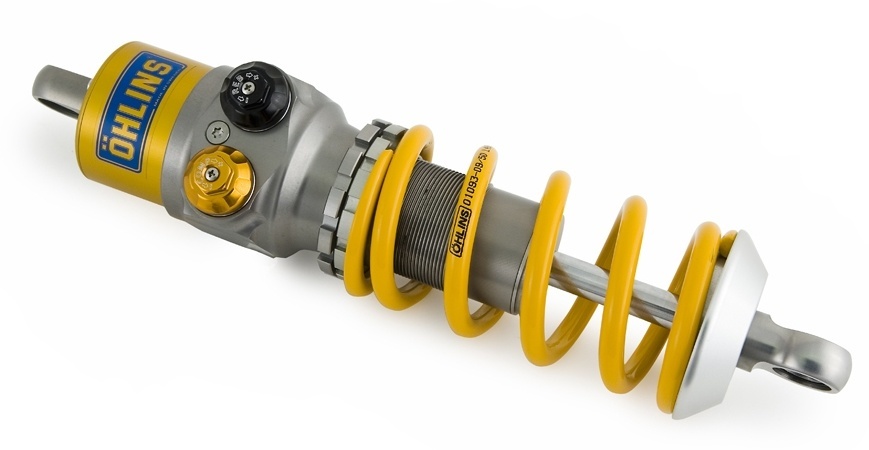
Many coilover kits offer adjustable damping, though not every kit does, so check carefully whether damping adjustment is included before completing your order. How damping adjustment works can vary considerably from one manufacturer to another, but it generally involves opening or closing an internal bypass bleed port. The bypass is a calibrated orifice in the piston rod or valve assembly that governs low-speed damping behaviour. As the piston moves up and down when the car drives over bumps, damper oil is forced through orifices and shim valves in the piston—allowing the damper manufacturer to define the damping curve. Different manufacturers use varying valve architectures to influence this, but the underlying hydraulic principle is the same.

When the damper shaft moves very slowly up and down, oil flows through the bypass bleed port with relatively little resistance. Once the piston moves faster, the oil can no longer pass quickly enough through the bypass port alone and instead forces open secondary ports held closed by preloaded valve shims or springs. Turning the adjuster knob closes or opens the bypass bleed further, dictating how early and aggressively the oil must push through the main spring-loaded shim valves. Through port geometry, shim stacks, valve types, oil viscosity and internal materials, the manufacturer tailors how the damper reacts across different conditions—closely guarded trade secrets that damper engineers rarely publicise.
1-way adjustable (single adjuster)
Typically adjusts either rebound alone (extension stroke, when a check valve restricts the bypass bleed to one direction) or bump (compression) and rebound together in a fixed ratio. Straightforward for beginners to set up: simply dial the damper firmer or softer to suit your preference until the car absorbs road imperfections cleanly without bouncing or wallowing.
2-way adjustable (dual adjusters)
Compression (bump) and rebound (extension) strokes each get their own dedicated bypass bleed circuit. One adjuster knob opens or closes the compression bleed, while the second knob independently opens or closes the rebound bleed. This gives greater tuning freedom—for example, if you find that the car absorbs bumps well in compression, yet does not extend the tyres back onto the tarmac quickly enough through a dip. Making full use of 2-way adjustment requires a well-developed feel for the car and plenty of seat time to sense what change the chassis needs.
3-way and 4-way adjustable
With these systems, the manufacturer even provides independent adjustment for high-speed and low-speed shaft velocities across compression and rebound strokes. Truly benefiting from 3-way or 4-way adjustability demands experience across varied circuit conditions and surfaces, combined with a solid grasp of race car balance and vehicle dynamics. A discerning enthusiast can still benefit from this on a road car because you rely far less on a fixed factory compromise setup, though keep in mind that dialling it in properly requires a serious investment of time—or entrusting the setup work to a professional.
How many clicks:
The number of adjustment clicks actually tells you nothing in itself: each click is simply a tiny spring-loaded ball bearing inside the adjuster knob dropping into a detent recess every fraction of a turn, and has zero direct effect on the hydraulics. In fact, you can leave the knob positioned halfway between two clicks if you want an intermediate setting. Bypass port diameter, the number of bleed orifices and the adjuster thread pitch determine how much effect turning the knob actually has on damping force—and that differs enormously between manufacturers. The contrast between a Tein kit (subtle, fine increments per click) and a GAZ kit (sweeping all the way from very soft to rock-hard), for example, is a world apart.

Electronic adjustment
More and more systems are reaching the market that allow coilover damping to be adjusted via an in-cabin button, smartphone app or the car’s factory OEM controls. Because every system is specific to its manufacturer, it is difficult to generalise—some homework is needed to establish exactly what each system can and cannot do. If you would rather skip that research, feel free to contact us so we can work out together which solution is best suited to your vehicle and requirements.


Nitron Elec-TRON:
Nitron offers an Elec-TRON variant across their replacement dampers as well as their R1 and R3 series coilover kits. These dampers plug straight into the factory OEM damper control system, such as BMW EDC or Porsche PASM. Simply install the suspension, plug in the electrical connectors and drive.
If your car does not have factory control for electronically actuated dampers—or if you want a sharper, faster-reacting and more tuneable system—brands such as Nitron also offer an external DCU (Damper Control Unit). Equipped with built-in G-sensors, this standalone control unit handles active damper management regardless of what car you drive. Using the supplied rotary switch you can select between different preset maps, or connect your laptop to custom-calibrate every parameter for your exact driving conditions.
On the Elec-TRON R3 coilover kits, you can also make additional mechanical damping adjustments directly on the damper body alongside the electronic control.

Advanced damping features:
The higher the price bracket of a coilover kit, the greater the likelihood that the manufacturer incorporates clever internal engineering features to overcome the limitations of conventional hydraulic damping.
Thermostat:
Higher-end kits incorporate an internal thermostat that adjusts damping as the shock absorber warms up: as damper oil heats up it thins out, which would otherwise leave the damper feeling softer, and the thermostat automatically compensates for that viscosity change.
Gas pressure:
Dampers are pressurised with gas to prevent cavitation in the damper oil. When a damper has to work hard over sustained bumps or kerbs, unpressurised damper oil can aerate into a frothy emulsion, causing a major loss of damping resistance. Pressurising the hydraulic chamber prevents foaming and keeps damping consistent, while also acting as a slight supplemental pneumatic spring rate.

Variable damping:
To apply the right damping force in every situation, advanced dampers feature velocity- and direction-sensitive valving systems. Chassis dive under braking and body roll in corners produce relatively slow damper shaft speeds that you want to support firmly, whereas driving across a pothole at high speed demands that the wheels maintain maximum contact with the road—meaning you want minimal damper resistance during that rapid extension stroke. Higher-end coilover kits combine these hydraulic valving solutions with calibration developed through years of motorsport experience and innovation—an area where European manufacturers remain far ahead of the competition.

Bump stops:
Bump stops are typically polyurethane elastomers fitted over the piston rod between the damper body and the chassis top mount, or mounted between the control arm and chassis. Their role is to absorb heavy compression impacts whose energy exceeds what the main spring and damper valving alone can handle. In principle your springs and dampers should absorb almost all road inputs, but the softer and more comfort-oriented the setup, the harder it becomes to prevent bottoming out. For that reason, some high-end dampers feature an internal hydraulic bump stop—a system that progressively ramps up damping force right as the damper approaches the end of its compression stroke. This takes up less suspension travel than an external elastomer bump stop and rounds off the end of the stroke cleanly. In practice, if you hit a large crest or bump too hard, you avoid the harsh metallic thud of the damper bottoming out against its mechanical stop, as the impact is progressively absorbed.
Steering knuckle / strut housing mounting:
Many OEM dampers bolt or clamp to the chassis and steering knuckle / upright. That is ideal when upgrading to coilover suspension: you order the kit built to your specification, it arrives in a box and you bolt it straight onto the car. There are cases, however, where the lower knuckle or spindle brackets on the struts are too intricate to reproduce economically, are not strong enough for motorsport loads without reinforcement, or are permanently welded to the factory strut housing. In those instances, you have to send your existing front knuckles / strut housings to the manufacturer so they can modify and build them into a complete bolt-on coilover strut assembly—leaving you without your knuckles while the work is carried out. For the BMW E30, we keep an exchange set of front strut housings in stock to save you that downtime.

Installation:
In our workshop we have the space and specialist equipment to install shock absorbers, springs, anti-roll bars, control arms, subframe bushings and modifications, and more—providing the complete chassis solution for your car.

Wheel alignment:
After installing or adjusting virtually any suspension component, a full wheel alignment is essential. During alignment we set the wheels to the correct geometry angles relative to the chassis for optimal grip, handling characteristics and tyre longevity.
Corner weighting:
Following installation of height-adjustable coilover suspension, corner weighting is a valuable option. It is not strictly mandatory—especially on a daily-driven road car whose weight distribution constantly changes with passengers, luggage and fuel load—but for fast-road and track-focused driving, optimal corner-weight balance is vital for neutral, symmetrical handling that makes the car more controllable and predictable on the limit.
With coilover suspension you set the ride height at each corner of the chassis, which directly governs the vertical load carried by each wheel. If the left-rear wheel carries substantially more static load than the right-rear wheel, the unloaded right-rear tyre will break traction earlier and wear faster—and the car will react very differently to throttle inputs in a right-hand corner compared with a left-hand corner.
(Limited-slip) differential response to the suspension
Differential behaviour—and the operation of any limited-slip differential (LSD)—is governed by the grip and vertical load distribution across the driven wheels. Consequently, your suspension setup has a direct influence on how the differential performs. With an open differential in particular, uneven wheel loads or poor suspension control amplify inside-wheel spin, whereas a limited-slip differential can often mask or compensate for minor suspension shortcomings while maximising traction.