The first-generation 1 Series (E81, E82, E87, E88) and fifth-generation 3 Series (E90, E91, E92 and E93) share a large proportion of their mechanical engineering; suspension, drivetrain and related components are interchangeable in many cases, even with the M models. Straight from the factory, these platforms feature a remarkably stiff chassis and direct steering, making them ideally suited to motorsport and fast road driving. Below is an overview of our preferred upgrades and preventative maintenance:

Limited-slip differential:
We supply a limited-slip differential (LSD) for every 1 Series and 3 Series model (116i, 320d, 135i, 1M Coupé, M3 — all variants). Our webshop includes an online configurator for the 130i and 330i. For all models, you can request a quotation here.
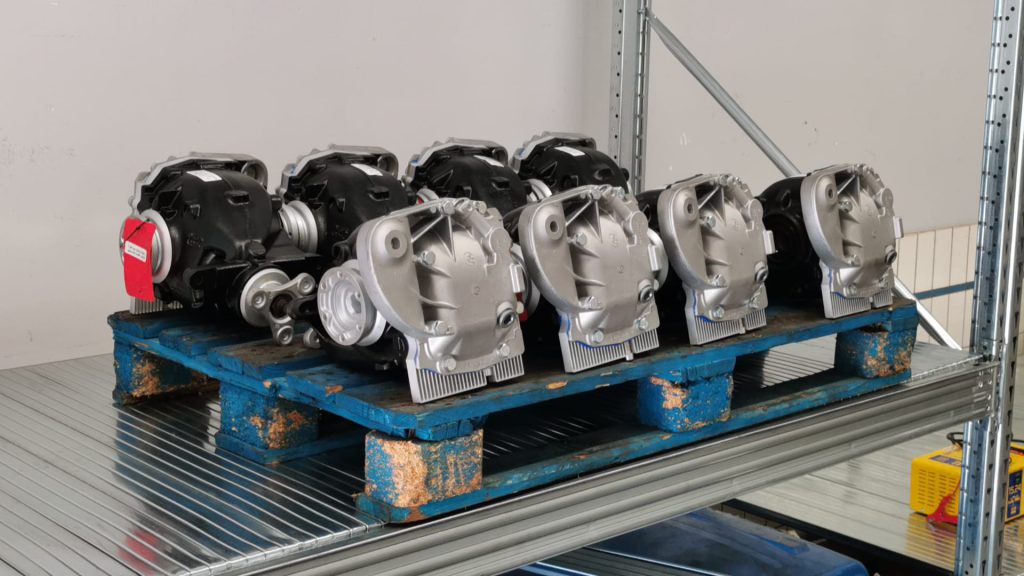
M3 and 1M Coupé differential
The differential housing and gearset of the M3 and 1M Coupé are extremely robust and easily handle well over 700 bhp. Unfortunately, the factory LSD core inside the casing is a less durable GKN visco-actuated clutch-type LSD featuring an asymmetric design. As its clutch plates wear over time, internal pressure within the unit gradually drops. Once this occurs (typically between 100,000 and 150,000 km), the driveline begins to clunk. Play develops at the right-hand short output flange inside the differential, causing an intrusive knocking noise.

While this is an unwelcome maintenance expense on one hand, on the other it presents an ideal opportunity to carry out a worthwhile mechanical upgrade at the same time. Because the S65 V8 delivers its peak performance primarily in the upper rev range, fitting a shorter final drive ratio is the single most effective way to keep the engine on the boil. (See: https://hardemanmotorsport.nl/algemene-informatie-sperdiff/aangepaste-differentieel-verhouding/)

Alongside the final drive ratio, we strongly recommend upgrading the limited-slip differential unit itself. The factory GKN Variable M Differential Lock is marketed as a sophisticated unit capable of locking anywhere from 0 to 100%. That sounds impressive on paper, yet it takes noticeable time to build locking torque and only begins reacting once it is already too late — after one wheel has started spinning. In practice, the moment you demand traction is never a matter of minutes or even seconds. Especially on circuit, and equally on the road, you want immediate, progressive lock-up.

For that reason, we supply replacement clutch-type LSD cores from the E39 M5 (ZF), OS Giken or Drexler. These mechanical Salisbury-style clutch-type limited-slip differentials are dynamically far more capable as well as significantly more durable: they can be fully rebuilt when needed, are mechanically stronger thanks to a symmetric housing and cross-pin design, and deliver vastly longer service intervals between rebuilds. See how these limited-slip differentials compare here: https://hardemanmotorsport.nl/sper-differentielen-vergelijken/
Furthermore, after roughly 20 years in service a complete bearing and seal overhaul is often due as well, which we handle in-house. Contact us for technical details and pricing.
Anti-roll bars:
Factory anti-roll bars on many BMW models are on the thin side, and those fitted to these 1 Series and 3 Series chassis — particularly at the rear — are exceptionally light. Giving the rear axle in particular an upgrade transforms the handling balance of your 1 Series or 3 Series, dialing out the overly conservative understeer bias BMW builds in from the factory. The catch with the rear anti-roll bar is that it routes over the top of the rear subframe, meaning the subframe has to be lowered for installation; we therefore recommend combining this job with upgraded subframe bushings.

Control arms and subframe:
The standard rubber rear subframe bushings are remarkably compliant, allowing substantial deflection under load. Whenever the subframe shifts relative to the bodyshell, rear toe and camber change dynamically — undermining rear-end stability and predictability at the limit. We therefore recommend fitting firmer polyurethane or solid aluminium subframe bushings for a far more communicative and precise-handling chassis. Differential mounting bushings are best kept in rubber to prevent gear whine from transmitting into the cabin. In addition, front and rear control arms can be upgraded with spherical bearings (uniballs) or adjustable rear arms to set camber and toe accurately. Factory wheel alignment settings are likewise conservative, and a proper geometry setup unlocks substantial cornering grip. Both the front and rear axles can also be retrofitted with E90 M3 control arms, gaining an extra half degree of negative camber for stronger front-end bite on turn-in.

We also offer a pre-built exchange subframe to minimise workshop downtime when installing new bushings or overhauling your rear axle. We can supply this freshly powder-coated and pre-assembled with rubber, polyurethane or aluminium bushings, alongside adjustable, reinforced and/or lightweight control arms, new wheel bearings, refurbished brakes and more.

Dampers and springs or coilover suspension:
Factory dampers on these BMW generations are fairly underwhelming across the entire model range and are thoroughly worn out by 100,000 km. On top of that, BMW valved them excessively soft to compensate for the stiff sidewalls of factory run-flat tyres. A set of replacement Bilstein B6, B8 or B12, Tein or Gaz dampers is an excellent starting point to give the car substantially better body control without sacrificing road compliance. Complete coilover suspension kits are also available starting from €626, already delivering a marked improvement over the OE dampers. Naturally, the benchmark solution remains a dedicated set of Öhlins or Intrax coilover suspension.

Brakes:
Almost all of these models leave the factory with typical single-piston sliding calipers, which carry high unsprung weight and fall short under sustained heavy braking. BMW recognised this themselves and equipped certain 135i models with an excellent set of Brembo fixed calipers, available as an M Performance brake kit for every non-M 1 Series and 3 Series model. Beyond a full caliper conversion, upgrading to higher-friction sport brake pads is already an effective first step towards stronger deceleration and fade resistance. We also stock braided stainless-steel brake lines, brass caliper guide bushes, replacement brake pedal bushes and high-boiling-point brake fluid for a firmer, more consistent brake pedal.

Differential rebuild:
One of our highest-volume services for the BMW 1 Series and 3 Series is a complete differential rebuild. These generations are notorious for premature pinion and carrier bearing wear. We rebuild each unit using heavy-duty tapered roller bearings with a significantly longer service life, fully derust and repaint the casing, and fit fresh oil seals throughout. Because we know how durable these rebuilt units are, we back every differential with a 2-year warranty.

Worn propshaft:
Premature differential bearing failure on these 1 Series and 3 Series models is occasionally triggered by a worn propshaft. When the needle bearings inside the universal joints begin to seize or bind at certain operating angles, they introduce a driveline vibration into the cabin — typically felt first under hard acceleration in the lower gears. That rotational binding transmits additional axial and radial load plus high-frequency vibration directly onto the differential pinion shaft, causing the input bearings to fail prematurely.
To cure this fault permanently, fitting a brand-new propshaft is generally the soundest engineering approach. BMW propshafts use staked universal joints that cannot simply be swapped out on the bench like conventional circlip-retained U-joints; new joints have to be machine-pressed, staked and the complete propshaft assembly dynamically rebalanced afterwards.
In our workshop experience, refurbishing an old BMW propshaft is difficult to guarantee to a 100% vibration-free standard. If a driveline vibration remains after refitting, it creates costly diagnostic uncertainty over whether the rebuilt propshaft itself is still at fault or whether the vibration originates elsewhere in the drivetrain. Installing a new complete propshaft eliminates this risk altogether.

Tyres:
From the factory, these cars came equipped with early-generation run-flat tyres (RFT). Their sole advantage is that in the event of a puncture, you can continue driving at reduced speed to the nearest workshop. However, the engineering drawbacks are numerous:
– Extremely stiff sidewalls transmit harsh impacts (both audible and physical) over road imperfections.
– Comparatively heavy tyre construction, increasing unsprung and rotational mass.
– Reduced mechanical grip because the rigid carcass cannot conform cleanly to the road surface (and run-flats are not offered in genuine high-performance compounds).
– Higher purchase price than an equivalent conventional tyre.
– Limited choice of manufacturers offering RFT fitments, such as Bridgestone, Pirelli, Vredestein, Continental, Dunlop, Michelin and Goodyear.
– More restricted availability.
– Workshop experience shows noticeably faster tread wear.
Switching to conventional non-run-flat tyres is straightforward and brings clear dynamic and ride-quality benefits, though it is sensible to carry a puncture contingency such as a 12V compressor with a tyre sealant/plug kit or a spare wheel. A Michelin Pilot Super Sport, for example, is a far more communicative, compliant and hard-wearing tyre that makes the chassis genuinely rewarding to drive.
