
Read the most frequently asked questions about limited-slip differentials (LSDs) below.
Who is a limited-slip differential suitable for and why is it used?
A limited-slip differential is primarily used in sports cars, off-road, race, rally and drift cars because it improves not only speed, but also traction on poor terrain.

What types of limited-slip differentials exist and which is most commonly used in sporty rear-wheel-drive vehicles?
There are three main categories: viscous, clutch-type and Torsen (helical), with clutch-type LSDs being the most widely used for performance applications in rear-wheel-drive vehicles. Read more
How does a clutch-type limited-slip differential work and what are its adjustment options?
A clutch-type limited-slip differential operates through friction generated by clutch plates and friction discs arranged in clutch packs; both the number of plates and the preload can be adjusted to regulate the locking percentage. Read more.
What is the importance of the final drive ratio in a limited-slip differential and how does it affect performance?
The final drive ratio defines how many revolutions the gearbox output shaft makes relative to the wheels; a shorter (numerically higher) ratio improves acceleration but lowers top speed, directly influencing vehicle dynamics and fuel consumption. Read more.
What is the most suitable limited-slip differential for drifting and what are the pros and cons of aggressive locking?
For drifting, a limited-slip differential with a high locking percentage is commonly used. High locking action—or an aggressive LSD setup—is the most predictable in behaviour and therefore easiest for the driver to control on throttle. In addition, strong locking generates maximum speed (equally crucial in drifting) as well as maximum tyre smoke.
Who uses a limited-slip differential?
Virtually all sports cars, as well as off-road 4x4s and heavy commercial trucks, for example. Beyond outright speed, traction over rough or low-grip terrain is another key reason to choose a limited-slip differential.
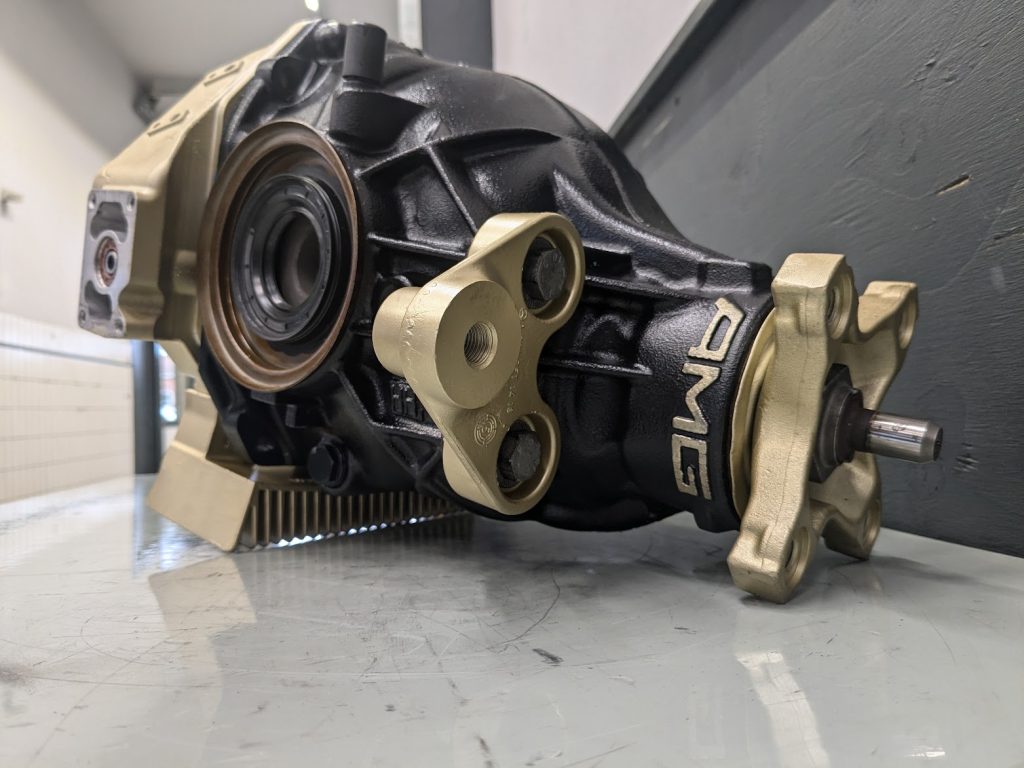
E63 AMG E-LSD conversion to OS Giken Superlock clutch-type LSD
Are there many different types of limited-slip differentials?
Yes, broadly speaking they can be divided into three categories: viscous, clutch-type and helical / Torsen (such as a Quaife). Here we focus on the clutch-type LSD, as this design is the primary choice for sporty and motorsport applications in rear-wheel-drive vehicles.
You can find more detailed information on the differences between limited-slip differentials here: https://hardemanmotorsport.nl/sper-differentielen-vergelijken/
Clutch plates
The operating principle of a clutch-type limited-slip differential (Salisbury / ZF style) is that locking action is generated through friction between clutch plates and friction discs. These are assembled together inside clutch packs. By adjusting the number of clutches and the preload tension, we can set how much locking torque the differential produces. This is expressed as a percentage—such as 25%, which is standard on most factory road-going sports cars. For more spirited fast-road driving, 40% is frequently chosen, while locking values of 75% are also used in rallying.
That’s it?
No, because a clutch-type LSD can be configured in many different ways via its ramp angles and preload, which define its dynamic handling characteristics. Below are the most common configurations:
- 1-way; locking action under acceleration only
- 2-way; locking action under both acceleration and deceleration (overrun)
- 1.5-way; locking action under both acceleration and deceleration, but half as much on deceleration
Combinations of the characteristics above are also possible, such as a 1.2-way setup.
What do I need?
Ideally, you want a differential that remains open off-throttle and locks fully under full throttle. Achieving that requires a dynamically responsive LSD, which is precisely where the technical challenge lies. With a budget LSD, manufacturers are forced to choose a static compromise, whereas top-tier LSD manufacturers deliver wide dynamic range—low locking under light throttle and strong, progressive locking under heavy throttle, ideally all the way up to 100%.
And what did BMW fit from the factory?
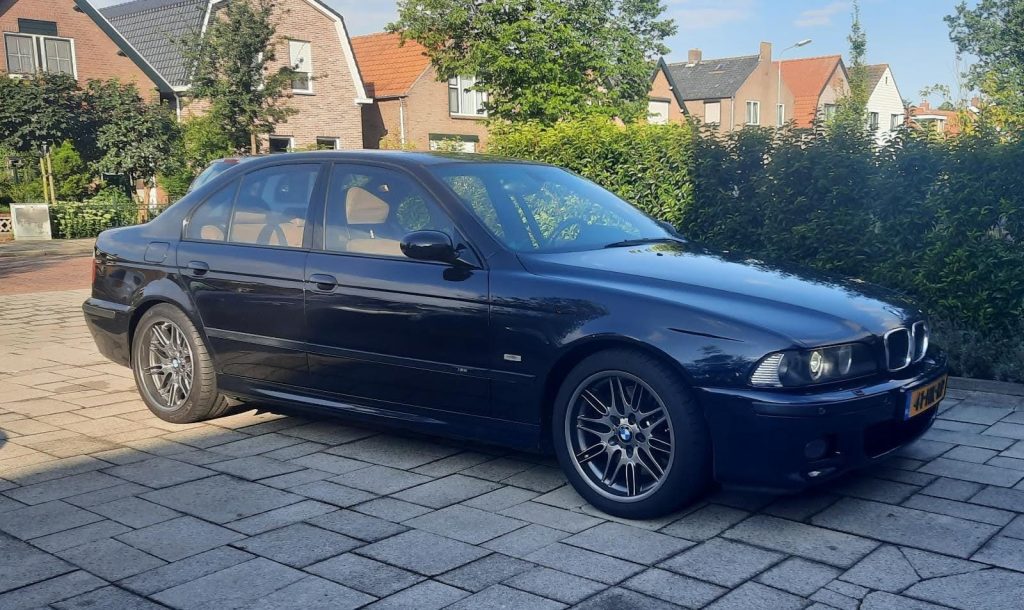
Factory BMW clutch-type limited-slip differentials up to 1999 are 2-way 25% units. Later, BMW introduced GKN viscous differentials in M models; these can generate between 15% and 100% lock, but because they only start locking once wheelspin is already present and build locking force slowly, they are less suited to circuit driving. From the F-series chassis onwards, M models have been fitted with an electronically actuated clutch-type LSD. Particularly in the F10 M5, its dynamic behaviour is still quite similar to the viscous LSD; things improved somewhat with the F80, and only from the G80 M models onwards has BMW really got the calibration properly dialled in.
What about the viscous limited-slip differentials on the E30?
Those were not fitted for sporty applications, but exclusively on 4WD models. That viscous LSD is not suitable for motorsport use either; it serves primarily as a traction aid in slippery conditions.
I have an electronic differential lock, what does that mean?
An electronic differential lock on a non-M BMW (E8x through F3x generations) is not a true limited-slip differential, because the locking action is not carried out by the differential itself. Underneath the car sits an ordinary open differential paired with an electronic watchdog. As soon as one wheel registers an excessively high rotational speed relative to the other wheel, the system brakes that spinning wheel. Imagine accelerating out of a corner: because the car leans onto the outside tyre, the unloaded inside wheel has less grip and starts to spin. Due to the design of an open differential, drive torque is no longer sent to the outside wheel—even though that wheel actually has the most grip. The electronic system intervenes by applying the brake to the inside wheel. Because braking creates resistance at the inside wheel, torque is once again transferred across to the outside wheel.
This is a safe everyday system, particularly in combination with traction control and ESP. However, as you can imagine, braking while accelerating is neither the most efficient nor the quickest way to propel a car forward—and for drifting it is not an option at all. On top of that, these brake-intervention systems on a BMW react slowly, making it difficult to predict how the chassis will respond: the system detects slip, clamps the brake briefly, releases it again, and then waits for substantial wheelspin to build up once more.
A proper mechanical limited-slip differential—in place of the open differential—engages immediately and provides mechanical traction before the electronics even need to step in. That makes the car far more efficient and noticeably faster without interfering with or fighting the electronic driver aids. And with those electronic safety systems switched off, the car becomes far more rewarding to drive as well.
Differential final drive ratio explained
Whenever a (limited-slip) differential is discussed, the final drive ratio is almost always mentioned in the same breath—but what is that ratio exactly? It is very straightforward and is best compared to the rear sprockets on a racing bicycle.
Choose a large sprocket (with many teeth) and pedalling feels light and easy, though you cannot ride very fast. Choose a small sprocket and pedalling feels heavier, but you can reach a much higher top speed.
When a differential crown wheel & pinion is marked 4.10, for example, it indicates a reduction ratio of 4.10:1. The output shafts leaving the differential (going to the wheels) turn 4.10 times slower than the input shaft entering the differential (coming from the gearbox). In other words, the higher this number, the easier it is for the engine to turn the wheels. In practice, this means stronger acceleration. Because the engine runs at higher RPM for a given road speed, however, your top speed will be lower:
Higher (shorter) final drive ratio; faster acceleration and lower top speed
Lower (taller) final drive ratio; slower acceleration and higher top speed
Many of our customers choose a slightly higher (shorter) final drive ratio so the car pulls harder and feels livelier, since they rarely drive at maximum top speed anyway. Even so, the ratio cannot be raised endlessly—nobody wants to sit on the rev limiter at 120 km/h in 5th gear with a 130 km/h top speed, and fuel consumption will also change accordingly. Finding the right balance is therefore essential. By way of example, BMWs delivered from the factory with a 3.73 ratio are frequently converted by us to 3.91 or 4.10. Selecting a shorter final drive ratio is an attractive upgrade for many drivers because the car accelerates noticeably quicker without any increase in engine power.
For further details, you can read and see more here: https://hardemanmotorsport.nl/algemene-informatie-sperdiff/aangepaste-differentieel-verhouding/
We can calculate the exact difference and theoretical top speed for your vehicle without obligation. Please contact us for more information.

Drifting
What is the best limited-slip differential for drifting?
For perfectionists and competitive professionals, we can build a 4-plate or 6-plate clutch-type limited-slip differential. The benefit is 2x or 3x the friction surface area compared to a standard 2-plate LSD, substantially increasing both durability and locking torque.
Why is 100% less effective than 80%?
Drifting with a 100% locked differential is a popular entry-level choice. With rare exceptions, these are welded open differentials, making them an inexpensive option. However, it is far from ideal because in serious drifting you do not want both rear wheels forced to turn at the exact same speed at all times. Particularly during left-to-right transitions, allowing the rear wheels to rotate at different speeds makes chassis transitions far smoother than with a rigid 100% lock. Professional drift drivers therefore do not run 100% lock. Another drawback is that the extreme mechanical loads on a welded differential can cause sudden failure, writing off the entire differential on the spot—and potentially the car itself if it lets go at the wrong moment.
What about the OS Giken Superlock?
While priced slightly above our upgraded ZF clutch-type LSD units, it is an exceptionally capable clutch-type limited-slip differential for drifting. Its biggest advantage is that the differential features up to 12 clutch plates. This makes the unit virtually wear-free, meaning practically no rebuild of the friction discs is required. Formula Drift world champion Daigo Saito runs an OS Giken Superlock in his 1,200 hp Lexus SC430.
For more information, please contact us or
Request a quote for a limited-slip differential