
Does your car judder, hesitate, or bind during acceleration or tight low-speed turns, or has a 4×4 / xDrive / DSC / PSM fault warning appeared on the dashboard? On modern all-wheel-drive vehicles such as BMW xDrive, Porsche Cayenne/Macan, Mercedes-Benz 4MATIC, and Range Rover, the root cause is very frequently a worn or overheated wet multi-plate clutch pack or stretched chain inside the transfer case. Hardeman Motorsport rebuilds transfer cases in-house at our workshop in Kruiningen (NL) — typically within one working day, with upgraded heavy-duty parts in stock and a standard 2-year warranty.
Interactive 3D Simulator: What Does the Transfer Case Clutch Do & Why Does It Wear Out?
Use our interactive 3D cutaway simulator below to see how the direct rear main shaft, wet multi-plate clutch pack, servo ball-ramp actuator, and front-axle chain drive work together. Test for yourself what happens inside the clutch pack when driving on a flat or underinflated tire, running mismatched tire circumferences, or subjecting the drivetrain to heavy 4WD / towing loads:
What Purpose Does the Clutch Inside a Transfer Case Serve?
Most modern longitudinal-engine AWD platforms (including BMW xDrive 1 through 8 Series and X1–X7, Porsche Cayenne, Macan and Panamera, and many Mercedes-Benz 4MATIC models) do not use a traditional open gear-type center differential. Instead, they rely on an electronically controlled active transfer case equipped with a wet multi-plate clutch:
- 100% direct main shaft to the rear axle: The gearbox output shaft passes straight through the transfer case to the rear propshaft. Under normal cruising conditions, the car retains the natural balance and steering feel of rear-wheel drive.
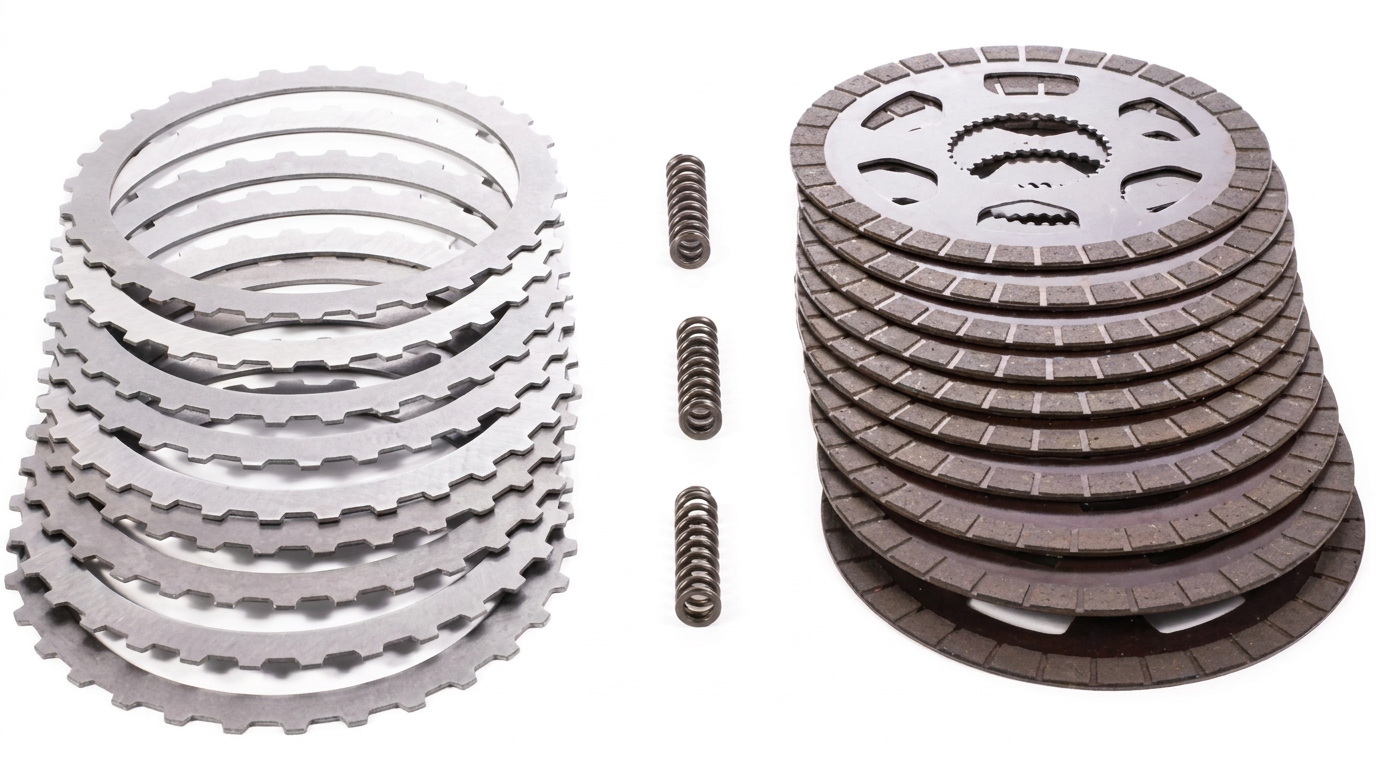
- Infinitely variable torque transfer to the front axle (0% to 50%): Surrounding the main shaft sits an oil-bathed clutch pack consisting of alternating splined steel inner plates (turning with the rear axle) and lined friction discs (coupled via a silent Hy-Vo chain or gear train to the front differential).
- High-speed electric servo & ball-ramp actuator: Whenever wheel-speed, steering-angle, and throttle sensors detect hard acceleration, wet tarmac, or incipient rear wheelspin, an electric servo motor rotates a ball-ramp ring within milliseconds—clamping the clutch pack to route the exact required torque to the front wheels.

Why Does the Clutch Wear Out? Flat Tires, Tire Circumference & Heavy 4WD Use
Because there is no open planetary center differential between the front and rear axles, any rotational speed difference between the front and rear wheels while the clutch is clamped must be absorbed purely as friction slip inside the multi-plate clutch pack. In our rebuild workshop we see three primary causes of premature transfer case failure:
1. Driving on a Flat / Soft Tire or Mismatched Tire Circumference (The #1 Silent Killer)
This is by far the most underestimated cause of burned-out transfer cases. When all four tires have an identical rolling circumference (within a strict 1% maximum tolerance, i.e. less than ~2 mm tread depth difference front-to-rear), both axles spin at virtually the exact same RPM on a straight road and clutch slip is negligible.
However, the moment you continue driving on a punctured or underinflated tire (for example 1.1 bar instead of 2.5 bar), fit a mismatched space-saver spare, replace only two rear tires while the fronts are worn, or run staggered wheels without OE-matched rolling circumferences (such as BMW * star-marked tires), the effective rolling circumference easily differs by 2% to 5%. That triggers a destructive chain reaction:
- Non-stop forced clutch slip — every single kilometer: At a 3.5% circumference mismatch, one axle is forced to cover 35 meters more rollout distance per kilometer than the other axle. At 100 km/h on a straight motorway, the inner steel plates and outer friction plates grind past each other continuously by dozens of RPM.
- The 4WD ECU clamps the clutch even harder: Reading the ABS wheel-speed sensors, the control unit misinterprets the constant RPM delta as wheelspin and commands the servo motor to apply extra clamping pressure instead of releasing it.
Because an active transfer case holds only 0.6 to 0.9 liters of fluid and rarely has an external oil cooler, over 1,000 Watts of friction heat is dumped into less than a liter of oil. Within a single motorway trip on a soft tire, oil temperatures can exceed 200 °C—scorching the fluid black, glazing the friction linings, and warping the steel separator plates.
2. Intensive 4WD Load (Heavy Towing, Off-Road / Snow & High-Torque Launches)
Frequent towing of heavy horse boxes, boat trailers, or car transporters, driving through deep sand, mud, steep Alpine passes, or snow, and repeated full-throttle launches (especially on tuned high-torque engines) demand sustained maximum actuator clamping force under dynamic slip. Over time this causes rapid thermal oil breakdown, clutch pack wear, stretching of the Hy-Vo drive chain, and bearing wear.
3. Degraded Transfer Case Fluid (The ‘Lifetime Oil’ Myth)
Many manufacturers market the transfer case fill as lifetime oil. In reality, mechanical shear, moisture, and heat deplete the delicate friction modifiers inside that tiny 0.8-liter oil bath within 50,000 to 80,000 km. Once the lubricating film breaks down, stick-slip shudder sets in: instead of gliding smoothly during cornering or gentle acceleration, the clutch plates grab and release erratically.
Common Symptoms of a Worn or Failing Transfer Case
- Juddering, jerking, or hesitation under acceleration: Most noticeable between 30 and 80 km/h under moderate throttle—frequently misdiagnosed as an automatic gearbox torque-converter shudder or engine misfire.
- Drivetrain binding or hopping in tight turns: Noticeable scrubbing, knocking, or resistance beneath the center console when parking or pulling away on full steering lock.
- 4×4 / xDrive / DSC / ABS / PSM fault warnings: When clutch wear pushes the servo actuator beyond its calibrated travel threshold, the ECU disables AWD and stability control to prevent further mechanical damage.
- Metallic rattling, slapping, or whining noises: A stretched drive chain can skip teeth under load or contact the aluminum casing, while worn bearings produce a speed-dependent whine.
- Complete loss of drive: On several platforms, worn splines on the output flange or primary shaft can strip completely.
2-Minute Workshop Diagnostic Tip: Unsure whether a shudder is coming from the automatic transmission or the transfer case? Temporarily unplugging the transfer case servo actuator connector (or pulling its fuse so the clutch remains open in 100% RWD mode—note this will trigger a temporary 4×4 warning light) isolates the unit immediately. If the juddering vanishes completely on a test drive, the transfer case clutch pack is confirmed as the culprit.
What Does a Transfer Case Rebuild at Hardeman Motorsport Include?
Rather than gambling on a used salvage unit whose clutch pack is often already heavily worn, every transfer case at Hardeman Motorsport is completely stripped, inspected, and rebuilt in-house to exacting tolerances:
- Complete disassembly, industrial cleaning, and inspection of the casing, oil pump/scoop, and internal lubrication passages;
- Brand-new OEM-grade multi-plate clutch pack (both friction discs and flat steel separator plates), precision-shimmed to exact clearance specs;
- Replacement of ball bearings, needle bearings, shaft seals, and O-rings;
- Inspection and replacement where required of the Hy-Vo silent drive chain, ball-ramp actuator assembly, and servo worm gear;
- Upgraded reinforced parts in stock for known factory weak spots such as stripped output flanges and primary shafts;
- 1-working-day turnaround (including optional drive-in removal, refitting, fresh OE-spec fluid fill, and ECU calibration/adaptation reset), over 400 exchange differentials and transfer cases on the shelf, and a standard 2-year warranty.
Transfer Case Models We Frequently Rebuild
| Make & System | Transfer Case Type | Common Vehicle Applications |
|---|---|---|
| BMW xDrive (E-Series) | ATC300, ATC350, ATC400, ATC450, ATC500, ATC700 | E90/E91/E92 3 Series, E60/E61 5 Series, E83 X3, E53/E70 X5, E71 X6 |
| BMW xDrive (F- & G-Series) | ATC35L, ATC45L, ATC13, ATC13-1 | 1, 2, 3, 4, 5, 6, 7 & 8 Series xDrive, F25/G01 X3, F26/G02 X4, F15/G05 X5, F16/G06 X6, G07 X7 (see also BMW X5 & xDrive) |
| Porsche PTM | PL72, Hang-On clutch & transfer case | Cayenne (955 / 957 / 958 / 9YA), Macan (95B), Panamera 4 / 4S / Turbo / GTS |
| Mercedes-Benz 4MATIC | Integrated & bolt-on 4MATIC transfer cases | C-Class, E-Class, S-Class, GLC, GLE, GLS & AMG 4MATIC(+) models |
| Land Rover / VAG / Other | Magna / BorgWarner / Torsen & clutch units | Range Rover & Range Rover Sport, Discovery, VW Touareg, Audi Q7 (plus transverse PTO/Haldex angle gears — see Differential & PTO Rebuilds) |
Maintenance Advice to Prevent Future Wear
- Change your transfer case fluid every 45,000 to 60,000 km (or every 40,000 km when towing regularly), including resetting the ECU wear adaptations.
- Keep all four tire rolling circumferences matched: Check tire pressures regularly, never keep driving on a soft or punctured tire, keep front-to-rear tread depth differences within 2 mm, and use OE star-marked (
*) tires on staggered BMW xDrive setups.
Ready to have your transfer case diagnosed, rebuilt, or shipped as a ready-to-fit exchange unit? Request a tailored quote with your VIN, view our exchange transfer cases on Motorsportparts.nl, or call / WhatsApp us at +31 (0)113 700266.