
Every year we supply many different types of rubber, polyurethane, PTFE (Teflon), and aluminium bushings for subframes, control arms, and differentials, as well as engine mounts, flex discs (guibos), and shock absorber mounts. What is the sensible choice and what is right for your car? In this guide, we explain the materials and mounting positions in detail.

The standard rubber bushings that isolate your drivetrain and suspension from the chassis eventually require replacement over time (typically after around 15 years, depending on usage and operating conditions). Rubber dries out, cracks, or in high-temperature areas even crumbles.
Furthermore, factory-fitted rubber is often on the soft side for fast-road driving, and certainly for competitive motorsport use. For example, BMW fits stiffer rubber compounds across virtually all mounting positions on an M3 compared to a 330i.
Across the industry, standards exist for measuring the hardness of isolators and dampers using the so-called Shore rating:

Materials:
Rubber
Rubber is what vehicle manufacturers commonly use across many positions in the car—anywhere damping and isolation are required, such as spring pads, control arm mounting points, shock absorber mounts, engine and gearbox mounts, steering racks, subframes, differentials, transfer cases, propshafts, and more.

Rubber has the advantage of being inexpensive to manufacture and mould, readily available in various hardness grades, capable of bonding strongly to metal, and able to withstand both tensile and compressive loads. As a result, rubber covers a very wide range of vibrations that it can damp. In other words, it absorbs everything from very light vibrations right through to heavy impacts.
Rubber bushings are also sometimes designed with voids to allow greater compliance in a specific direction and to absorb a broader range of vibrations.
In more modern cars, rubber bushings are often filled with fluid to provide targeted damping characteristics. These are known as hydro-bushings (or hydraulic mounts). Once they start leaking, they lose much of their effectiveness and require replacement regardless.

A clear sign that your rubber bushings need replacing is visible cracking—lever them slightly with a pry bar and any splits become easy to spot. Rubber generally copes poorly with plasticisers present in oil, wide temperature fluctuations, grit, and road salt, as all of these cause drying out and cracking.
Ultimately, however, rubber provides the highest level of comfort compared to materials such as polyurethane or PTFE (Teflon). On the other hand, particularly when fitted with outer metal sleeves, rubber bushings are often quite difficult to press out and install compared to polyurethane or aluminium (placing those in the freezer beforehand often allows them to go in fairly easily).

Polyurethane (Urethane)
An alternative to rubber is polyurethane (urethane). Polyurethane is a polymer with rubber-like properties. The aftermarket bushings we supply generally have a slightly higher Shore rating (stiffness) on average than factory rubber bushings, because polyurethane works purely in compression and does not stretch in tension (otherwise there is an increased risk of tearing). The inner metal sleeve is not bonded to the polyurethane, meaning all damping comes solely from compressing the polyurethane rather than pulling on it. In addition, polyurethane manufacturers typically use solid, void-free bushings, which accounts for the biggest difference compared to voided OEM rubber.

The harder the bushing, the tauter the car becomes and the better the bushing handles heavy impacts, though it will also transmit more noise and vibration to the rest of the car (meaning it is less effective at isolating minor high-frequency shocks). Changing just a single bushing on the car from Shore 50 to Shore 80 will be very difficult to feel or hear, particularly on a control arm or a flex disc. When installing a complete vehicle kit, however, the difference can be clearly noticeable. The mounting location also strongly dictates how perceptible the effect is, as certain components generate or transmit far more vibration than others.

A major advantage of polyurethane is that it does not dry out or perish. Oil, temperature fluctuations, and road salt have little to no effect on its service life. Conversely, polyurethane is less suitable for applications where the bushing is subjected to tensile (pulling) loads, as this can cause tearing—even though rubber will eventually tear there too. Polyurethane bushings are generally much easier to install and remove than rubber ones, resulting in faster installation times, easier DIY fitment, and lower labour costs, especially since polyurethane itself does not have to be expensive.
We supply polyurethane in several hardness grades or Shore ratings:
Shore A 70:
Powerflex Yellow
Shore A 80:
Powerflex Purple
Strongflex Red
Shore A 90:
Strongflex Yellow
Strongflex Black
IRP Blue
Shore A 95:
Powerflex Black

Judging the quality of polyurethane can sometimes be difficult. We have very good—in fact, virtually trouble-free—experience with Powerflex, IRP, and Strongflex. Because polyurethane is usually cast, it is essential that no air bubbles are trapped inside the material. Furthermore, as noted earlier, proper engineering and bushing design are crucial to prevent heavy tensile loads from pulling on the polyurethane.
Hard Engineering Plastics (Delrin / PTFE)
Delrin (Shore D83) and PTFE / Teflon (Shore D50–60) are engineering plastics that no longer fall within the Shore A scale because they are too hard for it. These rigid plastic bushings are used on more motorsport-oriented cars. Because they exhibit virtually zero deflection and are relatively economical to machine, yet are not quite as harsh as solid aluminium, they represent a solid middle ground for certain applications. The stiffer your mounts, the less power is lost compressing rubber components, and the less compliance there is for the wheels to deflect in unintended directions. Driver feedback regarding what is happening within and underneath the car also improves significantly.

If you require custom Delrin or PTFE (Teflon) bushings for your project, let us know—from a simple sketch on paper we can quickly machine a set of bushings. With PTFE, however, it is important to keep thermal exposure in mind, as these bushings must not get too hot and will soften as temperatures rise.
Aluminium
Aluminium is a solution primarily intended for motorsport use. Aluminium does not deflect at all, turning a compliant connection into a completely rigid mount. Aluminium is lightweight, withstands high compressive loads and automotive fluids, and is straightforward to machine to custom dimensions. We do not recommend solid aluminium in applications that must rotate or articulate; in those positions, a spherical bearing is better suited.

In motorsport applications, components are subjected to much higher stresses. Under high G-forces, rubber bushings allow excessive movement—a well-known example being E30 race cars pushing the viscous fan through the radiator under hard braking. Furthermore, excessive flex from rubber mounts compromises structural stiffness, steering feel, wheel control, chassis feedback, and drivetrain efficiency.

If you require custom aluminium bushings for your project, let us know—from a simple sketch on paper we can quickly machine a set of bushings.
Spherical Bearings (Uniballs)
Spherical bearings (uniballs) can be used in a number of chassis locations and are particularly suited to control arms, anti-roll bar mounts, and shock absorber mounts that need to articulate cleanly in a specific direction. They are widely used in motorsport, though road-going performance cars also adopt them—for instance, a BMW M3 uses more spherical bearings in place of rubber joints than a 330i, and the same applies to a Porsche 911 GT3 compared to a standard 911.

Provided they are of high quality, spherical bearings are very durable and often last considerably longer than rubber mounts. On control arms, spherical bearings deliver smooth, bind-free suspension travel that follows the exact kinematic arc of the control arms. As a result, wheel attitude is guided far more accurately. This ensures that alignment settings such as toe and camber cannot be negatively affected or altered under varying cornering and braking loads, giving you a car that is more predictable, controllable, and communicative.
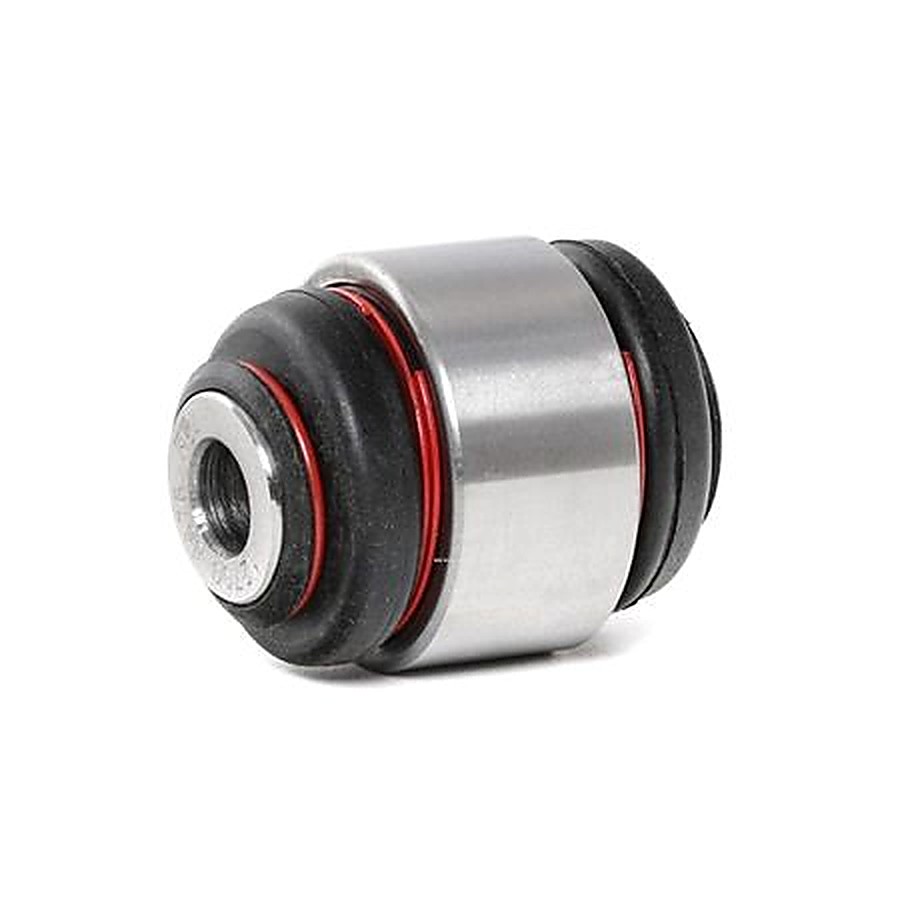
Differences in spherical bearing quality largely come down to material selection. Some bearings require periodic lubrication and are fitted with a grease nipple. The spherical joints fitted by BMW as OEM equipment are also of high quality and typically last a long time; equipped with a rubber dust boot, they are impervious to flying gravel, moisture, and sand. That does not mean exposed spherical bearings are immediately vulnerable to dirt—Fluro’s motorsport and low-maintenance series incorporate a polymer wiper ring that keeps contaminants away from the ball.

Used spherical bearings (uniballs) can be inspected for wear by checking whether any free play is present; if play can be felt, they are due for replacement.

Brass and Sintered Bronze
In locations where plastic is used as a plain sliding bushing, we offer alternatives machined from brass or sintered bronze. Brass is a highly scratch- and score-resistant material with good low-friction sliding properties, making it a tighter, more precise, and significantly more durable upgrade.
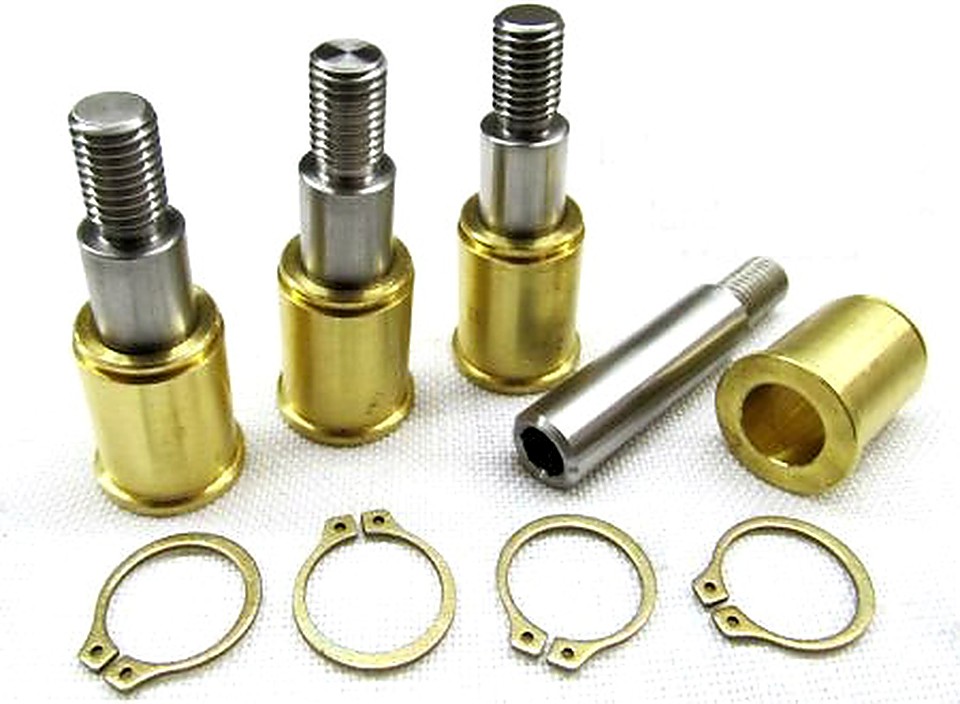
Sintered bronze is used in locations where the self-lubricating property of this porous alloy proves beneficial and the bronze construction enhances long-term wear resistance.
Mounting Positions:
Depending on the car, recommendations on which materials to choose can vary considerably based on parts availability, budget, and chassis design. Below is an overview of general guidelines on what works best in each situation.

Gearbox Mounts
Gearbox mounts are relatively sensitive components when it comes to vibration transmission. A gearbox mount must absorb both compressive and tensile loads. Under hard braking, the engine pitches and pulls the gearbox upwards; under heavy acceleration, the engine pushes the gearbox downwards. For this reason, the gearbox mounts should ideally be made from a similar material and stiffness grade as the engine mounts so they work together without placing excessive stress on the gearbox-to-engine bellhousing joint.

The stiffer the gearbox mounts, the more noise and vibration from the gearbox and engine are transmitted to the chassis (depending on internal gearbox clearances, oil specification, how smoothly the engine runs, etc.), but the more precise the car is to shift and the more directly it turns in.
Propshaft
A propshaft is a balanced rotating component in the car, so unless it has gone out of balance due to worn universal joints, CV joint bearings, or physical damage to the shaft, it will not vibrate or generate noise on its own. Attached to the propshaft are two types of rubber components:
1. Flex Disc, Guibo, or Hardy Disc

This rubber disc absorbs torsional shock loads in the drivetrain. It ensures smooth drivability when abruptly lifting off or getting back on the throttle. It also cushions peak drivetrain stress and isolates noise and vibrations originating from the differential and gearbox. This is of major importance for overall drivetrain longevity—a shaft will fail much sooner if the flex disc is made overly rigid.

However, if the standard rubber flex disc is undersized, or if the car produces significantly more power than stock, it can be sensible to upgrade to a larger-diameter model (which often requires custom flanges on the gearbox, differential, and propshaft) or an aluminium/polyurethane version such as offered by IRP:

2. Centre Support Bearing
The centre support bearing is a bearing suspended inside a rubber diaphragm. Over time, this diaphragm can dry out or tear, leading to vibration, whining, or thumping under load. If a propshaft deflects too far out of alignment under load, the joints (CV joints or universal joints) are forced to operate at excessive angles, which in turn generates vibration. JXB Performance manufactures a rigid billet aluminium centre support bearing carrier with rubber isolators to support the shaft more accurately, limit deflection, and extend service life:

Differential and Transaxle
Across different vehicles, we encounter many different designs for differential mounting bushings. A differential inherently produces a slight humming or whining sound, so isolating this noise and absorbing shock loads in the drivetrain is the primary task of the rubber bushings holding the differential in place. Depending on the model, these bushings are located in the differential housing/cover itself, in the subframe, or in a dedicated mounting bracket as on the F-series M3.

Reinforcing the differential bushings reduces differential pitch under load. This prevents the differential from forcing the propshaft into an excessive operating angle, which under heavy use can cause mechanical damage and substantial drivetrain power losses. Regarding the durability of the differential itself, we have observed no difference between hard and soft bushings.
Control Arms
Control arm bushings sit at the pivot points where the control arm connects to the subframe or the upright/knuckle. Here too, rubber provides an isolated, damped feel. For the control arms, that translates into a degree of ride comfort, even though the volume of rubber in some of these bushings is fairly minimal.

As soon as the car corners and the tyres pull or push against the control arms, compliant bushings compromise the control arm’s function. The purpose of a control arm is to ensure that as the wheel moves up and down over road imperfections or under drivetrain forces, the wheel maintains the intended position relative to the road surface (camber and toe). If the control arm can be pushed out of position under load, wheel toe and camber change dynamically. Worn rubber bushings result in a car that is difficult to predict and feels floaty, wanders over road undulations, and is hard to align properly—leading to uneven tyre wear and an unsettled, uncertain feel behind the wheel.

Fitting harder bushings reduces this deflection, while switching to spherical bearings eliminates it completely. Furthermore, a spherical bearing does not twist or bind in torsion as the arm articulates, meaning the bushing itself adds no parasitic spring effect—allowing the dampers and springs to operate freely and as effectively as possible. In practice, this delivers a far more predictable car, smoother suspension travel, and clearer feedback on what the tyres are doing.
Engine Mounts
Engine mounts are a frequently underestimated part of the car. Overly soft or worn mounts make a car feel delayed on turn-in. That is because the heavy engine block can move around by a surprising amount (on the E30 325i, old original engine mounts were notorious for allowing the viscous fan to push through the radiator under hard braking). Effectively, a heavy pendulum hangs in the nose of the car: once steering input is applied, that mass initially wants to carry straight on before eventually following the rest of the chassis around the corner.
That delay feels like a car that is initially reluctant to turn into a corner. Fitting new or firmer engine mounts reduces this effect, right up to immediate, razor-sharp turn-in when truly rigid engine mounts are installed. Together with the gearbox mounts, engine mounts are also responsible for crisp, predictable gearshifts. If the engine and gearbox pitch and dive excessively under load, the position of the shift gates shifts as well, making it easier to mis-shift into the wrong gear. Increasing engine power can also exceed the damping and control capacity of original factory engine mounts.

Overly hard engine mounts, however, are distinctly noticeable in both feel and cabin noise. Internal combustion engines always exhibit slight inherent imbalances and load reversals, causing them to transmit vibrations and mechanical noise into surrounding components.
Brake Calipers
Single-piston sliding (floating) brake calipers are often fitted with rubber guide bushings. Over time, repeated heat cycles mean these rubber sleeves require replacement. In addition, compliance in the rubber causes part of the braking force under hard braking to go into compressing the rubber sleeves, allowing the caliper to twist slightly rather than clamping squarely onto the brake pads, which can cause tapered pad wear (particularly during track use).
Brass retains the same smooth sliding guidance as rubber in this position, while delivering a firmer, easier-to-modulate brake pedal and a caliper that applies clamping pressure squarely.

Brass guide bushings can require slightly more regular maintenance; if they begin to bind at all, cleaning accumulated brake dust out of the guide assembly may be necessary.
Gearshift Linkage
Across different marques, models, and gearbox types, quite different mechanisms are used to select gears. Particularly on manual gearboxes actuated via a shift rod linkage (whereas some cars use shift cables), the rubber linkage bushings are critical. Dried-out or worn rubber bushings leave the gear lever feeling as though it is floating loosely in its gaiter, devoid of feel and making it difficult to judge cleanly whether the right gear is engaged.

Replacing these rubber bushings with fresh OEM parts or firmer polyurethane equivalents restores positive gate definition and mechanical feel, reducing the likelihood of selecting the wrong gear or failing to engage a gear cleanly. In addition, chassis-mounted short shifters are available that bypass all factory rubber carrier bushings altogether and pivot solely on a spherical bearing for maximum feel and shift precision.

Shock Absorber Mounts
At the top and bottom, shock absorbers or coilover suspension units attach to the chassis and to the upright, control arm, or live axle. The task of the shock absorber or strut is to follow the vertical movements of the wheel, damping and controlling oscillations to keep the tyres in contact with the road. In doing so, continuous shocks and vibrations pass through the assembly. Because of the resistance in the damper and spring, part of this energy is transmitted into the chassis, making it audible and perceptible inside the car.
Making the shock absorber mounts stiffer allows more road noise and vibration into the cabin, but steering feel and road feedback improve, making it easier to judge how much grip the car still has in reserve and when breakaway is approaching.

Shock absorber top mounts are also available that allow direct adjustment of camber and caster; however, these camber plates are not available for every type of suspension layout. Camber plates incorporating compliant damping material are harder to find, because the benefit of a camber plate generally goes hand in hand with more spirited or track-oriented driving.
Anti-Roll Bar Mounts
Anti-roll bar bushings are the rubber mounts in which the anti-roll bar pivots. From the factory, these bushings are often fairly soft. This slightly delays the initial action of your anti-roll bar while preventing tyre and suspension noise from being transmitted directly into the chassis.

Harder bushings such as polyurethane ensure that as soon as load is applied to the anti-roll bar (putting it to work), energy is not lost compressing soft rubber first—instead, the anti-roll bar acts immediately. The impact on comfort from these small bushings is minimal, making them an effective upgrade for roll stability.
Anti-Roll Bar Drop Links
At its outer ends, the anti-roll bar connects to the control arms or suspension struts; on older cars, small rubber bushes are occasionally used here too. Although these rubber bushes are tiny, once torn they can cause a knocking sound in corners—even slight play in this linkage quickly becomes perceptible or audible. Nowadays, ball-jointed or spherical-bearing drop links are almost always used in this location.
Aftermarket drop links are often length-adjustable as well, which is ideal when the car is lowered.

Steering System
Depending on the vehicle make and model, rubber elements are used at various points in the steering system—either in the steering column shaft or for mounting the steering rack. The softer these rubber mounts are, the harder it is to feel what the front wheels are doing through the steering wheel; the firmer these bushings are, the clearer that steering feedback becomes. For many cars, we offer firmer polyurethane replacement bushings and couplings.

Subframe
A subframe is typically located at the front and rear of the car, serving as the structural frame supporting the drivetrain (engine, gearbox, or differential) and providing the mounting points for the suspension control arms. If there is excessive compliance in the subframe mounts, loads acting on the drivetrain or wheels affect the alignment of the drivetrain or wheels relative to the chassis. That can cause drivetrain vibration, unwanted rear-axle steer, and a loss of tyre grip. Fitting harder subframe bushings prevents this deflection, with the trade-off that impacts and noise from the drivetrain and suspension are transmitted more directly to the chassis. On the BMW F80 M3, for example, BMW chose to bolt the rear subframe solidly to the body shell without rubber bushings. This gives the car a remarkably taut rear axle with plenty of feedback, with the downside that road noise over rough surfaces is more noticeable.

Balance
Selecting the right bushing material is ultimately a balance between comfort and dynamic performance. The more rigidly the suspension and drivetrain are mounted to the chassis, the sharper the car’s roadholding becomes. The flip side is that noises, vibrations, and road impacts come through more noticeably into the cabin. Because passenger cars are generally engineered with comfort in mind, the art lies in optimising handling precision while sacrificing as little comfort as possible. Define a clear strategy beforehand to achieve the right goals and avoid replacing bushings multiple times. We are happy to advise you so you can decide which components best suit your build, and our workshop is also available to install new bushings on your car—from OEM rubber right through to solid aluminium.