
Through working on numerous customer E46 M3s as well as our own M3 over recent years, we have gained extensive experience in reinforcing, stiffening, making faster, and improving these outstanding driver’s cars. Below is an overview of what we can offer for your M3 or Z4:

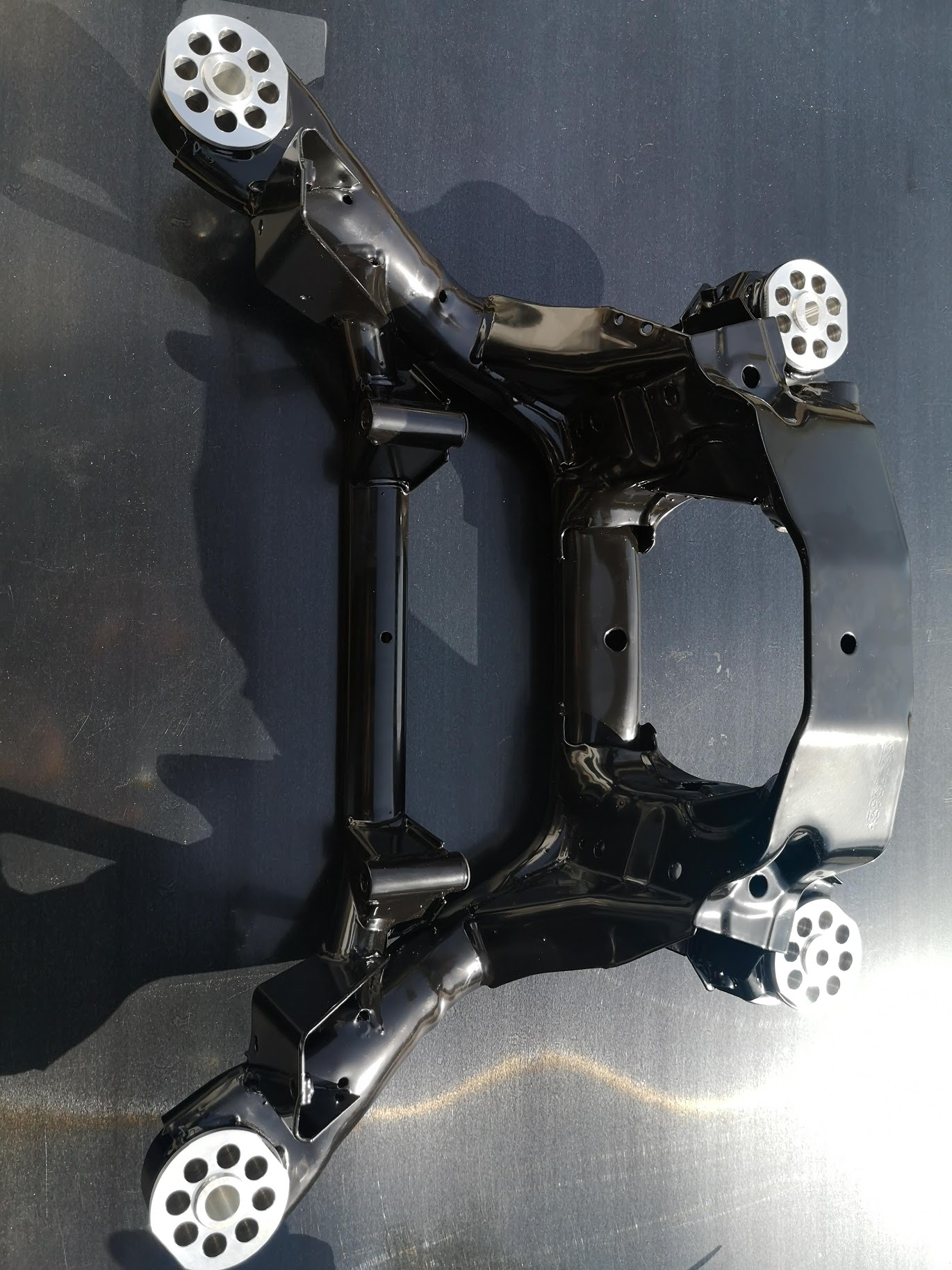
Subframe mount reinforcement / repairing chassis cracks:
The BMW E46 is notorious for developing cracks in the chassis floor (rear axle carrier panel) at the rear subframe mounting points. BMW introduced an official factory repair procedure for this issue, but it is typically only a temporary fix because the chassis floor can still crack again over time.

With our reinforcement kit, the chassis floor becomes strong enough that cracking no longer occurs, even under circuit use or drifting. In addition, we seam-weld the flanged edges, as the E46 also tends to split along those seams.


When installing the reinforcement kit, we also replace the brake lines routed above the fuel tank, as these frequently corrode, and we can replace all subframe, differential, and control arm bushings with OEM rubber, polyurethane, or spherical bearings (uniballs).

We also offer the option of having a rear subframe prepared by us on an exchange basis. You purchase a powder-coated subframe pre-fitted with polyurethane, rubber, or solid aluminium bushings. You then simply bolt it onto the car and return your old subframe afterwards, or have us install it while overhauling your differential or reinforcing the chassis mounting points.

Front axle control arm conversion:
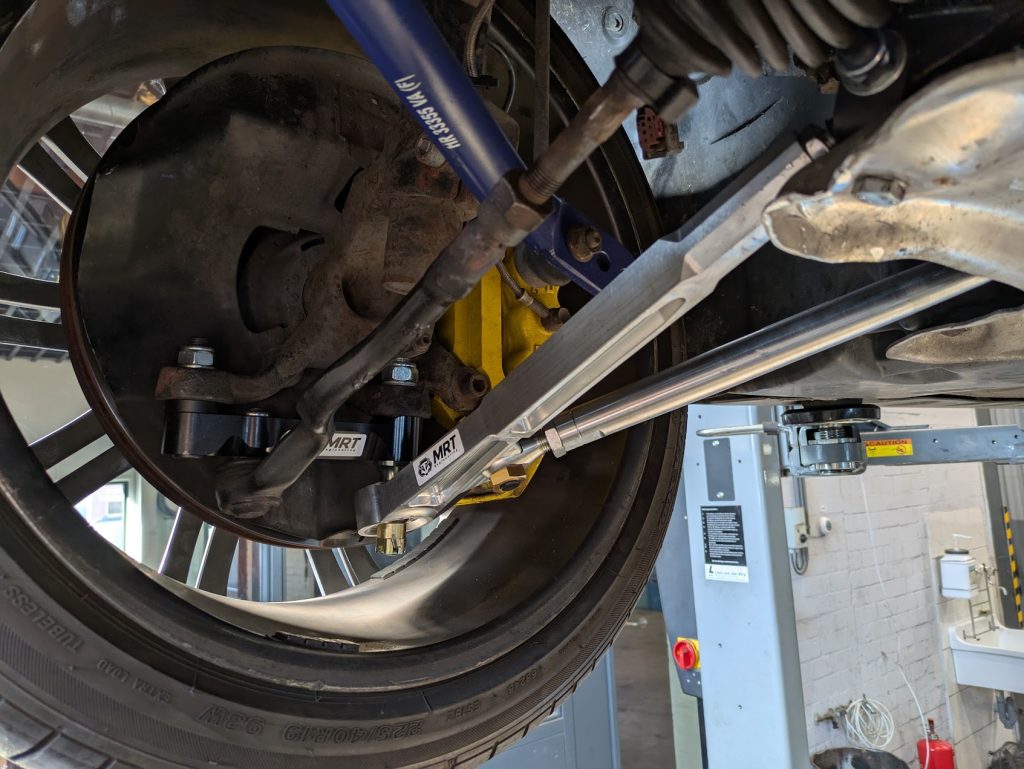
MRT Engineering offers a front control arm conversion with full adjustability for toe, camber, and caster, alongside options for roll-centre correction, bump-steer adjustment, and 30% quicker steering response with increased steering lock.
These complete kits, which assemble the entire front suspension on replaceable spherical bearings, maximise steering feel, chassis feedback, and wheel control for a car that responds and grips like a race car.
Differential:
Fortunately, the differential in the M3 and Z4M is very robust and can reliably handle up to 700 hp. Unfortunately, the factory limited-slip unit inside the differential is a less durable GKN viscous-actuated clutch-type LSD with an asymmetric design. The issue is that these clutch plates wear over time, causing internal pressure within the LSD unit to drop gradually. Once this happens (typically around 100,000 to 150,000 km), the drivetrain begins to clunk. The short right-hand output flange in the differential develops play and moves around, producing an annoying knocking noise.

While this wear is an unwelcome expense on one hand, on the other hand it is an ideal opportunity to perform a worthwhile upgrade at the same time. Because the S54 engine produces its power primarily at the top of the rev range, upgrading to a shorter final drive ratio (crown wheel & pinion) is the most effective way to keep the engine in its optimal powerband. (see: https://hardemanmotorsport.nl/algemene-informatie-sperdiff/aangepaste-differentieel-verhouding/)

Alongside the final drive ratio, we also recommend upgrading the limited-slip differential unit itself. The factory GKN Variable M Differential is marketed as an advanced LSD capable of locking anywhere from 0 to 100%. While that sounds great in theory, it takes noticeable time to build locking pressure, and actuation only starts once wheelspin has already begun — when it is already too late. In practice, the moment you need traction is not a matter of minutes or even seconds. Especially on circuit, as well as on the road, you want immediate traction.
For this reason, we supply replacement clutch-type LSD units from the E39 M5 (ZF), OS Giken, or Gripper. These multi-plate limited-slip differentials are dynamically much stronger as well as far more durable: they can be rebuilt over time, are stronger thanks to a symmetrical design, and last significantly longer between rebuild intervals. See how these limited-slip differentials compare here: https://hardemanmotorsport.nl/sper-differentielen-vergelijken/
Furthermore, after 20 years a full differential overhaul is sometimes required, and we can assist with that as well. Please contact us for details and pricing.
Rear trailing arm bushings (RTAB):
The rear trailing arm bushings on the E46 and Z4 are the same design as those used on the E36. These factory rubber bushings are not particularly stiff even when new, and over time they soften further and can tear. Particularly during circuit use or with modern high-grip tyres, these bushings can deflect laterally instead of solely pivoting.

When this bushing deflects laterally, it induces unwanted changes in rear camber and toe, causing the rear axle to steer passively under load. This produces an unsettled, vague feeling from the rear end that is undesirable during spirited driving. We therefore recommend replacing this bushing with a spherical bearing (uniball). It fits without play and cannot deflect in any direction other than its intended pivot axis, restoring a precise rear-axle feel while allowing the suspension to articulate smoothly.

Transmission tunnel brace and chassis stiffening:
Inspired by BMW’s factory engineering on the G80 M3, we developed a thick one-piece aluminium brace plate that connects all transmission tunnel mounting points together. Instead of two separate steel braces (which frequently rust), there is a single rigid aluminium plate.

Another recommended upgrade for chassis stiffening — which also acts as structural support for the rear subframe reinforcement — is the rear boot brace from PureTech Sweden. This brace ties the rear shock towers to the subframe mounting points via a rigid powder-coated tubular frame. The brace can be quickly removed temporarily should you ever need to carry bulky items in the boot.
