

The Torsen limited-slip differential (LSD) is a differential design that has existed since 1958 and operates on the principle of meshing helical gears. To understand how a Torsen differential works, it is important to know which specific variant is being used.

In short
How a Torsen LSD works is fairly difficult to visualise, primarily because its operation is continuously variable; we see many explanatory videos online miss the mark completely.

Therefore, in short:
A Torsen operates quietly and is virtually maintenance-free, but its operation depends on the available grip at both wheels it drives. In situations where grip is evenly distributed, a Torsen performs very well, whereas as the difference in grip between the two wheels grows larger, the Torsen struggles progressively more and becomes less effective at doing its job (its job being to send power to the wheel with the most grip). Because a Torsen's operation depends on a continuously changing condition (the grip level of one wheel relative to the other), it is somewhat harder for the driver to anticipate how it will react compared with, for example, a clutch-type LSD. Nevertheless, a Torsen is a 100% upgrade over an open differential with no drawbacks other than cost.
Torsen LSD simulator:
Torsen T-1
The first version of the Torsen LSD — the Type 1 (T-1) Torsen — features two large helical side gears on the inside and smaller helical element gears on the outside that mesh with each other. As long as both wheels on the axle rotate at the same speed, nothing happens internally and the differential carrier rotates as a single unit. However, when there is a difference in wheel speed between left and right, the meshing gears are able to rotate relative to one another to accommodate it.

This allows the car to corner smoothly without binding. However, as soon as one of the wheels loses traction (for instance in a tight corner), the so-called BIAS RATIO of the Torsen engages. Every Torsen unit has a torque bias ratio, which defines the proportion in which torque can be distributed across the axle. Different designs feature different ratios; we have seen values ranging from 2.5:1 up to 5.0:1. This bias ratio is determined by the pitch circumference geometry between the large side gears and the smaller element gears, and most manufacturers are fairly secretive about the exact bias ratio they use.
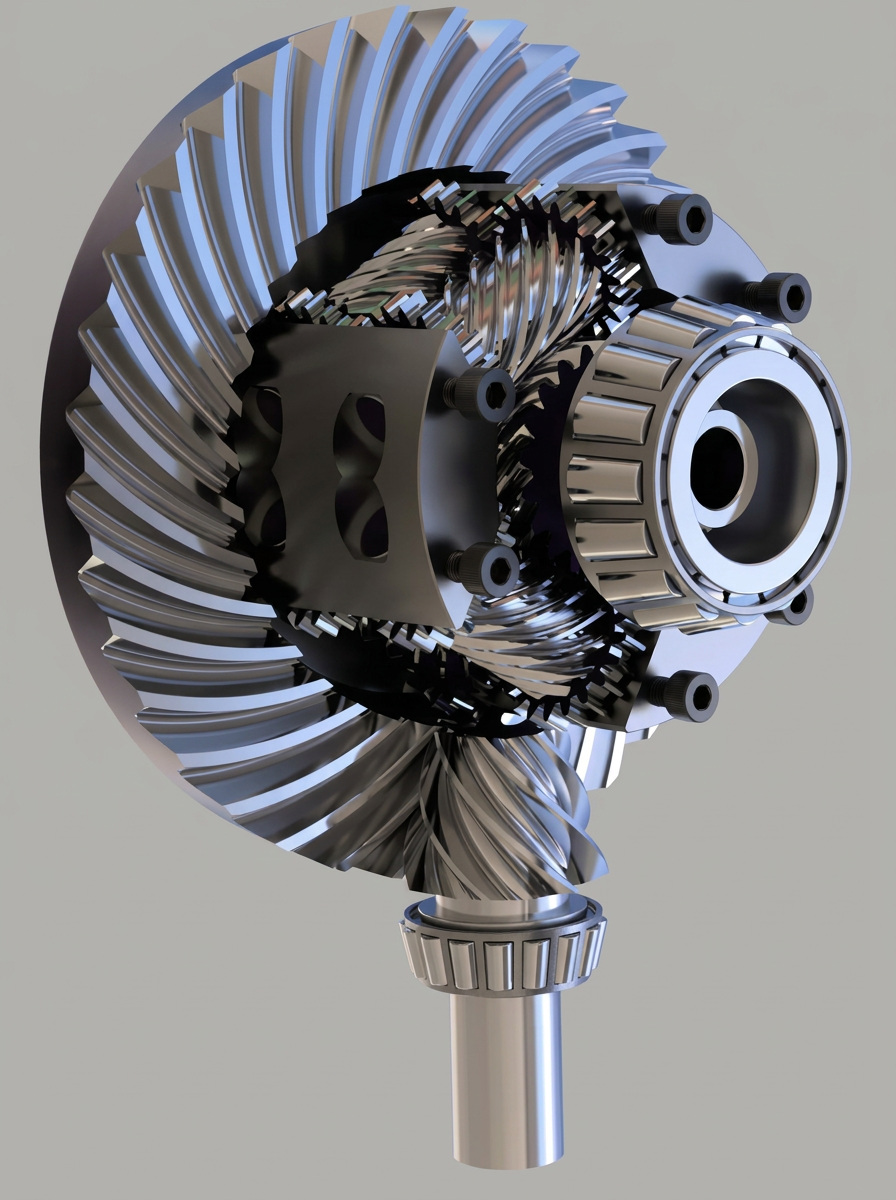
This torque bias ratio dictates how much torque is distributed between the wheels based on the amount of grip available at each tyre. It comes down to a simple calculation (taking 2.5:1 as an example). Suppose you accelerate and the engine delivers 100 Nm of torque to the rear axle equipped with the Torsen LSD. If one wheel has very little grip and the other wheel has plenty of grip, the calculation works as follows: a bias ratio of 2.5:1 multiplies the grip/resistance of the wheel with the least traction by 2.5. Assuming 10 Nm of resistance at the low-grip wheel, 2.5 * 10 = 25 Nm is sent to the wheel with high grip. Consequently, a substantial portion of the available torque is still lost to the spinning wheel. Furthermore, if one wheel has zero grip altogether, the formula becomes 2.5 * 0, which still equals 0. This is why a T-1 Torsen will not lock at all when one wheel is completely unloaded or airborne. A useful driver trick to overcome this is to lightly apply the handbrake, introducing some resistance to the wheel without grip (allowing the differential to generate torque bias again).
This operating principle also means that more wheel rotations occur on the slipping side to drive the gripping side. If the wheel on the low-grip side spins 2.5 revolutions, the wheel on the high-grip side rotates 1 revolution — albeit with higher torque, at a lower rotational speed. This is also why, with Torsen systems in general, single-wheel black marks can often still be seen on corner exit under hard driving.
The operation of a Torsen LSD is therefore continuously variable and dependent on the surface beneath the tyres. The more evenly grip is balanced across the driven axle, the better the differential performs. Conversely, right when you need the differential most (when there is little or no grip on one side), its effect is limited.
Torsen T-2
For that reason, the Torsen was re-engineered into the Type 2 (T-2) variant. The smaller helical gears were reoriented so that their axes run parallel to the large side gears. This created the advantage that as soon as torque bias or locking action is required, the gears are forced outward against the differential housing, generating internal friction resistance (meaning you are far less likely to need the handbrake trick).

The helical gear teeth naturally push away from one another under load. In doing so, the gears press against their machined pockets in the hardened housing, generating friction resistance and thereby transferring greater torque to the opposite wheel. This type of helical Torsen differential is more effective and is therefore essentially the only architecture used in modern aftermarket designs as well as contemporary factory-fitted Torsen differentials.

Variations on the Torsen LSD
In principle, all helical / Torsen limited-slip differentials operate according to this same concept. And there are quite a few manufacturers on the market: OBX, MFactory, ZF, Eaton, Quaife, Wavetrac, PG, and others.
First of all, there are differences in torque bias ratio: whereas OEM manufacturers typically select a relatively low bias ratio for very smooth road manners at the expense of outright traction (which leads some drivers to replace an OEM Torsen with an aftermarket unit), aftermarket helical LSDs are generally configured more aggressively.
Some manufacturers also combine the Torsen principle with another limited-slip mechanism to bridge its performance limitations under low-load conditions; the downside is that the unit quickly becomes complex and expensive, meaning such hybrid designs are not widely available across all platforms.
Quaife
The Quaife ATB design is the most widespread and is available for a vast range of vehicles. Quaife incorporates static preload using internal Belleville spring washers. As one of the largest aftermarket helical LSD manufacturers (having also supplied OEM units to Ford), Quaife is the most commonly used unit of its kind.

Wavetrac
Wavetrac developed an evolution of the helical Torsen design by adding a patented wave-profile cam device, visible in the centre of the image below. Through this wave hub, the differential generates internal load and resistance of its own to maintain drive as soon as one wheel begins to spin faster than the other. This internal load is carefully calibrated so the vehicle can still navigate corners freely. In a conventional Torsen design, zero-axle-load wheelspin is typically addressed by adding higher static spring preload, which in turn can induce understeer and tyre chatter in tight corners — drawbacks that the Wavetrac avoids.

Even so, the Wavetrac cannot completely prevent an unloaded inside wheel from spinning in every extreme situation. Particularly in rallying or heavy circuit use over kerbs, situations can still arise where you briefly need to lift off the throttle to regain traction.
Setup / overhaul
Overhauling a Torsen LSD is generally rarely required, though because it relies on rotating steel components sliding against one another under load, internal clearance can develop over time and lead to leaking axle oil seals. Especially if the differential has experienced repeated heavy wheelspin, some internal wear will eventually occur.

This can usually be resolved quite cost-effectively by reassembling the differential with fresh preload. That preload is generated by internal spring washers within the unit, which also makes it possible to tune the performance characteristics of the Torsen LSD. A Torsen set up with higher preload is less prone to inside-wheel spin and responds more rapidly (resulting in greater overall traction), though it may produce slightly more mechanical noise in tight turns and introduce a touch more initial understeer.
Installation
We can supply units from every major Torsen / helical LSD manufacturer and, in most cases, carry out full workshop installation as well. Contact us to discuss options and pricing for your application. View currently listed models directly in our webshop: www.motorsportparts.nl

Want to compare the Torsen LSD with other types and designs of limited-slip differentials? Open our differential comparison page for a table to sort them by function and behaviour: Compare limited-slip differentials